Identification of Correct Statements for Rate Law and Reaction Order
Consider the reaction , for which the rate constant at is . Which of the following statements are true ?
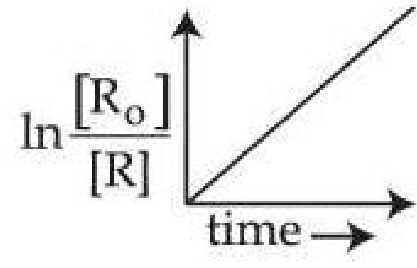
A. When concentration of 'X' is increased to four times, the rate of reaction becomes 16 times. B. The reaction is a second order reaction. C. The half-life period is independent of the concentration of X. D. Decomposition of is an example of the above reaction. E. The plot shown below is valid for the above reaction.
Choose the correct answer from the options given below :
Options
A and B Only
A, B and C Only
A, B, D and E Only
C and D Only
Topics & Concepts
Step-by-Step Solution
To determine the correct statements for the given reaction , we first analyze the rate constant and its units:
Given:
-
Order of the Reaction: The general unit for the rate constant of an -order reaction is given by:
Comparing the powers of or : Thus, the reaction is of second order.
- Therefore, Statement B is TRUE.
-
Effect of Concentration on Rate: For a second-order reaction, the rate law is expressed as:
If the concentration of is increased by times, i.e., , the new rate becomes: Hence, the rate of reaction increases by times.
- Therefore, Statement A is TRUE.
-
Half-life Period: The half-life period () for a second-order reaction is given by: The half-life is inversely proportional to the initial concentration of , meaning it is dependent on concentration (it is independent of concentration only for a first-order reaction).
- Therefore, Statement C is FALSE.
-
Decomposition of : The decomposition of is a standard example of a first-order reaction, not a second-order reaction.
- Therefore, Statement D is FALSE.
-
Graphical Representation: For a first-order reaction, the integrated rate equation is: This indicates a straight line passing through the origin when is plotted against time (). For a second-order reaction, the integrated rate equation is: Hence, the given plot of vs. is valid for a first-order reaction, not a second-order reaction.
- Therefore, Statement E is FALSE.
Conclusion: Only statements A and B are correct.
Thus, the correct answer option is A.