Height of Water Column Inside Submerged Inverted Cylinder
The piston is taken completely out of the cylinder. The hole at the top is sealed. A water tank is brought below the cylinder and put in a position so that the water surface in the tank is at the same level as the top of the cylinder as shown in the figure.
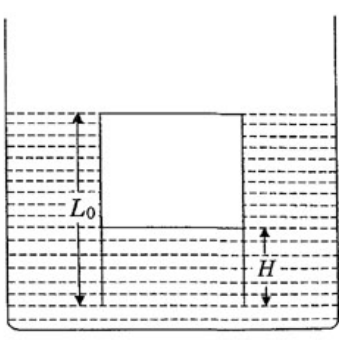
The density of the water is . In equilibrium, the height of the water column in the cylinder satisfies
Options
Topics & Concepts
Step-by-Step Solution
To determine the height of the water column inside the cylinder, we analyze the pressure and volume of the trapped air inside the cylinder before and after it is submerged.
1. Initial State of the Trapped Air:
Before the cylinder is submerged, the piston is removed and the hole at the top is sealed. The cylinder of total length and cross-sectional area is completely filled with air at atmospheric pressure .
- Initial Pressure:
- Initial Volume:
2. Final State of the Trapped Air (in Equilibrium):
The cylinder is placed vertically such that its sealed top is flush with the water surface in the tank. Water enters from the open bottom up to a height .
- The length of the trapped air column remaining at the top of the cylinder is:
- The volume of the trapped air is:
- The depth of the water-air interface below the free surface of the water in the tank is:
- Therefore, the hydrostatic pressure of the water at this interface (and hence the pressure of the trapped air) is:
3. Applying Boyle's Law:
Assuming the process occurs at constant temperature (isothermal conditions), the ideal gas law gives:
Substitute the initial and final values:
Canceling the common cross-sectional area :
Rearranging the terms:
Thus, the correct option is C.