JEE Challenger
More from Thermal Properties of Matter

Heat Transfer Through Partition in Insulated Container

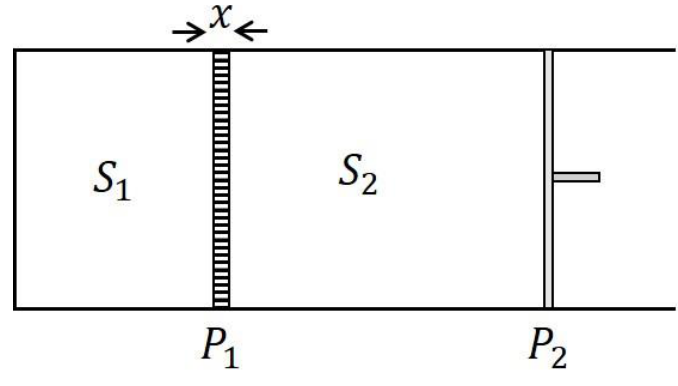
As shown in the figure, an insulated container is fitted with a thermally conducting but immovable partition (P1P_1) and a freely movable but thermally insulated piston (P2P_2). The partition P1P_1 with thermal conductivity KK, cross sectional area AA and width xx divides the container into two sections, S1S_1 and S2S_2, each containing one mole of a monoatomic gas. The piston P2P_2 moves freely such that the gas in S2S_2 is always at the atmospheric pressure. Initially, the difference between the temperatures of S1S_1 and S2S_2 is ΔT0\Delta T_0. The time it takes for the temperature difference to become ΔT02\frac{\Delta T_0}{2} is nxR/KAnxR/KA, where RR is the universal gas constant. The value of nn is: [ Given: ln20.7\ln 2 \approx 0.7 ]

Question Diagram 1
Official Numerical Answer0.63 to 0.7

Step-by-Step Solution

To find the time tt required for the temperature difference between the two sections to reduce to ΔT02\frac{\Delta T_0}{2}, we analyze the thermodynamic process in each section.

1. Nature of Thermodynamic Processes

  • Section S1S_1: Since the partition P1P_1 is fixed (immovable) and the container is insulated, the volume of S1S_1 remains constant. Thus, the process in S1S_1 is isochoric (constant volume). For 1 mole1\text{ mole} of a monoatomic gas: CV=32RC_V = \frac{3}{2}R

  • Section S2S_2: Since the piston P2P_2 is freely movable, the pressure of the gas in S2S_2 always equals the external atmospheric pressure. Thus, the process in S2S_2 is isobaric (constant pressure). For 1 mole1\text{ mole} of a monoatomic gas: CP=52RC_P = \frac{5}{2}R


2. Heat Transfer and Rate of Temperature Change

Let T1T_1 and T2T_2 be the instantaneous temperatures of the gases in S1S_1 and S2S_2 respectively, with T1>T2T_1 > T_2. The temperature difference at time tt is: ΔT=T1T2\Delta T = T_1 - T_2

According to Fourier's law of thermal conduction, the rate of heat transfer through partition P1P_1 is: dQdt=KAx(T1T2)=KAxΔT\frac{dQ}{dt} = \frac{KA}{x} (T_1 - T_2) = \frac{KA}{x} \Delta T

  • For gas in S1S_1, heat is lost at rate dQdt\frac{dQ}{dt}: dQ=1CVdT1=32RdT1    dT1dt=23RdQdtdQ = -1 \cdot C_V \cdot dT_1 = -\frac{3}{2} R \, dT_1 \implies \frac{dT_1}{dt} = -\frac{2}{3R} \frac{dQ}{dt}

  • For gas in S2S_2, heat is gained at rate dQdt\frac{dQ}{dt}: dQ=1CPdT2=52RdT2    dT2dt=25RdQdtdQ = 1 \cdot C_P \cdot dT_2 = \frac{5}{2} R \, dT_2 \implies \frac{dT_2}{dt} = \frac{2}{5R} \frac{dQ}{dt}


3. Differential Equation for Temperature Difference

The rate of change of temperature difference ΔT\Delta T is given by: d(ΔT)dt=dT1dtdT2dt=23RdQdt25RdQdt=(23R+25R)dQdt\frac{d(\Delta T)}{dt} = \frac{dT_1}{dt} - \frac{dT_2}{dt} = -\frac{2}{3R} \frac{dQ}{dt} - \frac{2}{5R} \frac{dQ}{dt} = -\left( \frac{2}{3R} + \frac{2}{5R} \right) \frac{dQ}{dt}

d(ΔT)dt=1615RdQdt\frac{d(\Delta T)}{dt} = -\frac{16}{15R} \frac{dQ}{dt}

Substituting dQdt=KAxΔT\frac{dQ}{dt} = \frac{KA}{x} \Delta T: d(ΔT)dt=(16KA15Rx)ΔT\frac{d(\Delta T)}{dt} = -\left( \frac{16 KA}{15 Rx} \right) \Delta T


4. Integration and Determination of nn

Separating variables and integrating from t=0t = 0 (where ΔT=ΔT0\Delta T = \Delta T_0) to time tt (where ΔT=ΔT02\Delta T = \frac{\Delta T_0}{2}):

ΔT0ΔT0/2d(ΔT)ΔT=16KA15Rx0tdt\int_{\Delta T_0}^{\Delta T_0/2} \frac{d(\Delta T)}{\Delta T} = -\frac{16 KA}{15 Rx} \int_{0}^{t} dt

ln(ΔT0/2ΔT0)=16KA15Rxt\ln \left( \frac{\Delta T_0 / 2}{\Delta T_0} \right) = -\frac{16 KA}{15 Rx} t

ln(12)=16KA15Rxt\ln \left( \frac{1}{2} \right) = -\frac{16 KA}{15 Rx} t

ln2=16KA15Rxt\ln 2 = \frac{16 KA}{15 Rx} t

Solving for time tt: t=(1516ln2)xRKAt = \left( \frac{15}{16} \ln 2 \right) \frac{xR}{KA}

Comparing this with the given expression t=nxRKAt = \frac{nxR}{KA}: n=1516ln2n = \frac{15}{16} \ln 2

Using the given approximation ln20.7\ln 2 \approx 0.7: n=1516×0.7=10.516=0.656250.66n = \frac{15}{16} \times 0.7 = \frac{10.5}{16} = 0.65625 \approx 0.66

Heat Transfer Through Partition in Insulated Container | Physics PYQ Solution - JEE Challenger