Heat Conduction Time Through Blocks in Series and Parallel Configurations
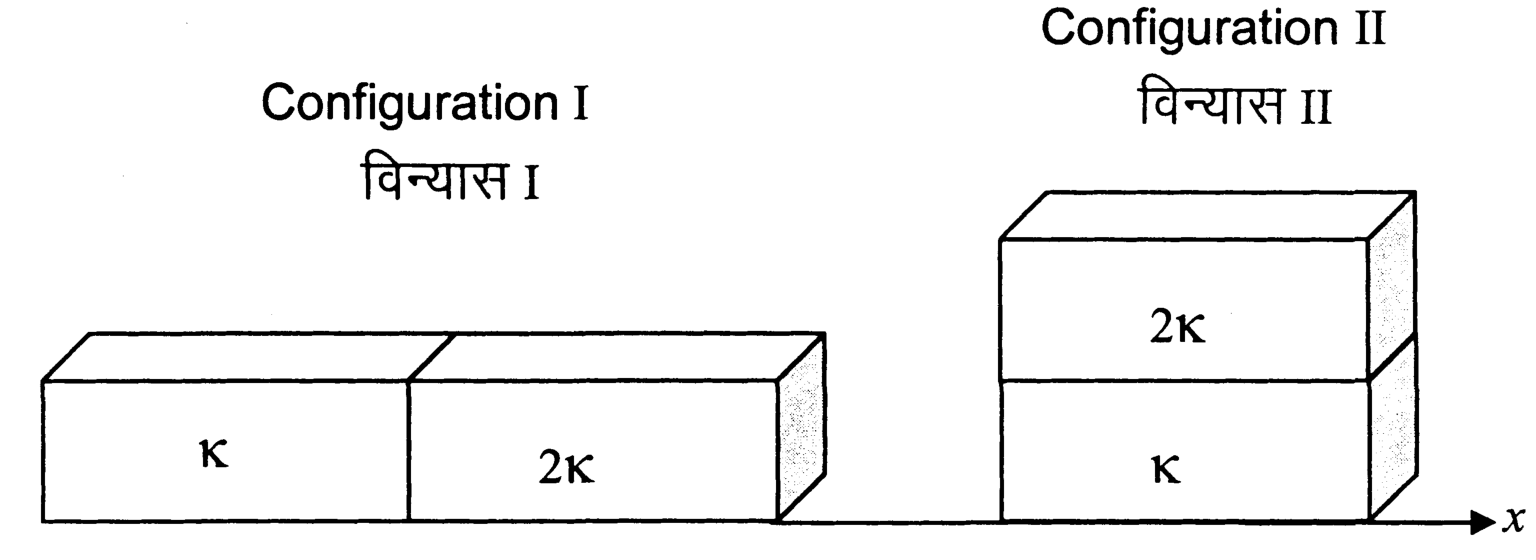
Two rectangular blocks of identical dimensions can be arranged either in configuration I or in configuration II, as illustrated in the figure. One block possesses a thermal conductivity of and the other of . The temperature difference between the opposite ends along the -axis is maintained the same in both configurations. If it takes to transfer a specific amount of heat from the high-temperature end to the low-temperature end in configuration I, the time needed to transport the identical amount of heat in configuration II is:
Options
Topics & Concepts
Step-by-Step Solution
To find the time required to transport the same amount of heat in Configuration II, we can use the concept of thermal resistance.
Let each rectangular block have a length along the direction of heat flow (the -axis) and a cross-sectional area perpendicular to the -axis.
The thermal resistance of a conductor is given by: where is the thermal conductivity, is the length along the heat flow, and is the cross-sectional area.
Configuration I (Series Connection):
The two blocks are connected in series along the -axis.
- Thermal resistance of the first block:
- Thermal resistance of the second block:
The equivalent thermal resistance for Configuration I is:
Configuration II (Parallel Connection):
The two blocks are arranged in parallel along the -axis.
- The equivalent thermal resistance for Configuration II is given by:
Relation between Heat, Time, and Thermal Resistance:
The rate of heat flow is given by:
For a constant temperature difference , the amount of heat transported in time is:
Since and are the same in both configurations:
Therefore, the ratio of the times taken is:
Given :
Thus, the correct option is (A).