JEE Challenger
More from Thermodynamics

Heat Absorbed in Monatomic Gas Quasi Static Cycle

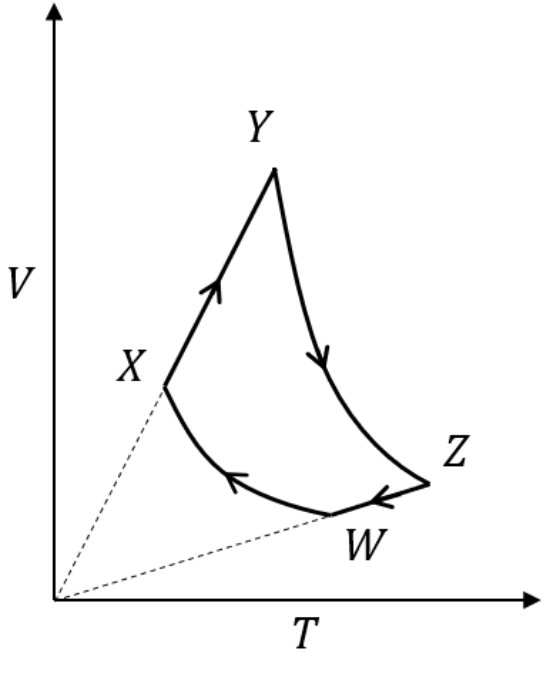
An ideal monatomic gas of nn moles is taken through a cycle WXYZWWXYZW consisting of consecutive adiabatic and isobaric quasi-static processes, as shown in the schematic VV-TT diagram. The volume of the gas at W,XW, X and YY points are, 64 cm364\text{ cm}^3, 125 cm3125\text{ cm}^3 and 250 cm3250\text{ cm}^3, respectively. If the absolute temperature of the gas TWT_W at the point WW is such that nRTW=1 JnRT_W = 1\text{ J} (RR is the universal gas constant), then the amount of heat absorbed (in J) by the gas along the path XYXY is ___

Question Diagram 1
Official Numerical Answer1.6

Step-by-Step Solution

To find the amount of heat absorbed by the ideal monatomic gas along the path XYXY, we analyze the processes in the thermodynamic cycle WXYZWWXYZW.

1. Thermodynamic Properties of an Ideal Monatomic Gas

For a monatomic ideal gas:

  • Degrees of freedom: f=3f = 3
  • Molar heat capacity at constant volume: CV=32RC_V = \frac{3}{2}R
  • Molar heat capacity at constant pressure: CP=52RC_P = \frac{5}{2}R
  • Adiabatic index (ratio of specific heats): γ=CPCV=53\gamma = \frac{C_P}{C_V} = \frac{5}{3}

2. Analysis of the Cyclic Processes

The cycle consists of consecutive adiabatic and isobaric processes:

  • Path WXWX: Adiabatic process.
  • Path XYXY: Isobaric process.
  • Path YZYZ: Adiabatic process.
  • Path ZWZW: Isobaric process.

3. State Variables at Point XX

For the adiabatic process WXWX, the relation between volume VV and temperature TT is given by: TWVWγ1=TXVXγ1T_W V_W^{\gamma - 1} = T_X V_X^{\gamma - 1}

Since γ1=531=23\gamma - 1 = \frac{5}{3} - 1 = \frac{2}{3}, we can solve for TXT_X: TX=TW(VWVX)2/3T_X = T_W \left( \frac{V_W}{V_X} \right)^{2/3}

Given VW=64 cm3=43 cm3V_W = 64\text{ cm}^3 = 4^3\text{ cm}^3 and VX=125 cm3=53 cm3V_X = 125\text{ cm}^3 = 5^3\text{ cm}^3: VWVX=64125=(45)3\frac{V_W}{V_X} = \frac{64}{125} = \left( \frac{4}{5} \right)^3

Substituting this ratio into the temperature relation: TX=TW((45)3)2/3=TW(45)2=1625TWT_X = T_W \left( \left( \frac{4}{5} \right)^3 \right)^{2/3} = T_W \left( \frac{4}{5} \right)^2 = \frac{16}{25} T_W

Multiplying both sides by nRn R and using the given value nRTW=1 Jn R T_W = 1\text{ J}: nRTX=1625nRTW=1625 Jn R T_X = \frac{16}{25} n R T_W = \frac{16}{25}\text{ J}

4. Heat Absorbed Along Path XYXY

Path XYXY is an isobaric process. The heat absorbed QXYQ_{XY} along an isobaric path is given by: QXY=nCP(TYTX)=n(52R)(TYTX)=52(nRTYnRTX)Q_{XY} = n C_P (T_Y - T_X) = n \left( \frac{5}{2} R \right) (T_Y - T_X) = \frac{5}{2} (n R T_Y - n R T_X)

By Charles's Law for an isobaric process, VYTY=VXTX\frac{V_Y}{T_Y} = \frac{V_X}{T_X}, which gives: TY=TX(VYVX)T_Y = T_X \left( \frac{V_Y}{V_X} \right)

Substituting TYT_Y into the equation for heat absorbed: QXY=52nRTX(VYVX1)Q_{XY} = \frac{5}{2} n R T_X \left( \frac{V_Y}{V_X} - 1 \right)

Given VY=250 cm3V_Y = 250\text{ cm}^3 and VX=125 cm3V_X = 125\text{ cm}^3: VYVX=250125=2\frac{V_Y}{V_X} = \frac{250}{125} = 2

Now, substituting nRTX=1625 Jn R T_X = \frac{16}{25}\text{ J} and VYVX=2\frac{V_Y}{V_X} = 2: QXY=52×1625×(21)=85=1.6 JQ_{XY} = \frac{5}{2} \times \frac{16}{25} \times (2 - 1) = \frac{8}{5} = 1.6\text{ J}

Heat Absorbed in Monatomic Gas Quasi Static Cycle | Physics PYQ Solution - JEE Challenger