JEE Challenger
More from Haloalkanes and Haloarenes

Halogen Exchange and Properties of Haloalkanes

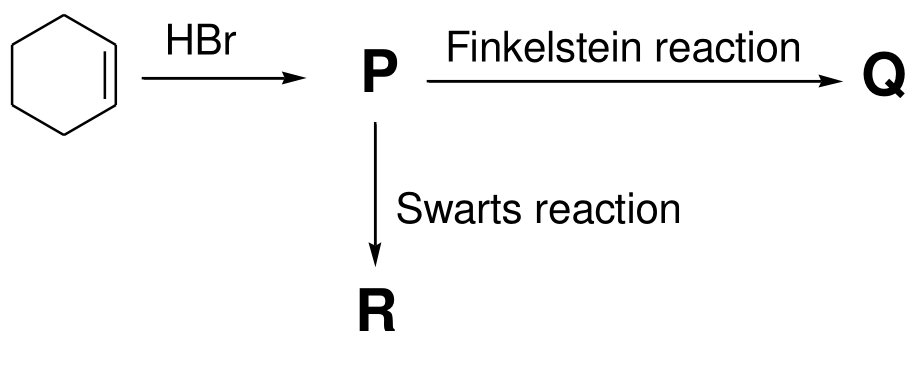
For the reaction sequence given below, the correct statement(s) is(are)

(In the options, X\text{X} is any atom other than carbon and hydrogen, and it is different in P\mathbf{P}, Q\mathbf{Q} and R\mathbf{R})

Question Diagram 1

Options

A

CX\text{C}-\text{X} bond length in P\mathbf{P}, Q\mathbf{Q} and R\mathbf{R} follows the order Q>R>P\mathbf{Q} > \mathbf{R} > \mathbf{P}.

B

CX\text{C}-\text{X} bond enthalpy in P\mathbf{P}, Q\mathbf{Q} and R\mathbf{R} follows the order R>P>Q\mathbf{R} > \mathbf{P} > \mathbf{Q}.

Correct
C

Relative reactivity toward SN2\text{S}_\text{N}2 reaction in P\mathbf{P}, Q\mathbf{Q} and R\mathbf{R} follows the order P>R>Q\mathbf{P} > \mathbf{R} > \mathbf{Q}.

D

pKa\text{p}K_\text{a} value of the conjugate acids of the leaving groups in P\mathbf{P}, Q\mathbf{Q} and R\mathbf{R} follows the order R>Q>P\mathbf{R} > \mathbf{Q} > \mathbf{P}.

Step-by-Step Solution

To determine the correct statement(s), let us analyze the reaction sequence step by step:

  1. Identification of Compounds P\mathbf{P}, Q\mathbf{Q}, and R\mathbf{R}:
    • Formation of P\mathbf{P}: Addition of HBr\text{HBr} across the double bond of cyclohexene yields bromocyclohexane. Cyclohexene+HBrP(Bromocyclohexane, C6H11Br)\text{Cyclohexene} + \text{HBr} \longrightarrow \mathbf{P} \quad (\text{Bromocyclohexane, } \text{C}_6\text{H}_{11}\text{Br}) Here, X=Br\text{X} = \text{Br}.

    • Formation of Q\mathbf{Q} (Finkelstein Reaction): Treatment of an alkyl bromide with NaI\text{NaI} in dry acetone replaces bromine with iodine. PNaI / acetoneQ(Iodocyclohexane, C6H11I)\mathbf{P} \xrightarrow{\text{NaI / acetone}} \mathbf{Q} \quad (\text{Iodocyclohexane, } \text{C}_6\text{H}_{11}\text{I}) Here, X=I\text{X} = \text{I}.

    • Formation of R\mathbf{R} (Swarts Reaction): Treatment of an alkyl bromide with metallic fluorides (e.g., AgF\text{AgF}, Hg2F2\text{Hg}_2\text{F}_2, CoF2\text{CoF}_2, or SbF3\text{SbF}_3) replaces bromine with fluorine. PMetallic FluorideR(Fluorocyclohexane, C6H11F)\mathbf{P} \xrightarrow{\text{Metallic Fluoride}} \mathbf{R} \quad (\text{Fluorocyclohexane, } \text{C}_6\text{H}_{11}\text{F}) Here, X=F\text{X} = \text{F}.


  1. Evaluation of the Options:

    • Option (A): CX\text{C}-\text{X} Bond Length As the size of the halogen atom increases down the group (F<Br<I\text{F} < \text{Br} < \text{I}), the CX\text{C}-\text{X} bond length increases: CI>CBr>CF    Q>P>R\text{C}-\text{I} > \text{C}-\text{Br} > \text{C}-\text{F} \implies \mathbf{Q} > \mathbf{P} > \mathbf{R} Therefore, option (A) is incorrect.

    • Option (B): CX\text{C}-\text{X} Bond Enthalpy Smaller halogen atoms form shorter and stronger bonds with carbon. The order of bond dissociation enthalpy is: CF>CBr>CI    R>P>Q\text{C}-\text{F} > \text{C}-\text{Br} > \text{C}-\text{I} \implies \mathbf{R} > \mathbf{P} > \mathbf{Q} Therefore, option (B) is correct.

    • Option (C): Relative Reactivity Toward SN2\text{S}_\text{N}2 Reaction The reactivity in nucleophilic substitution (SN2\text{S}_\text{N}2) strongly depends on the leaving group ability of the halide ion (I>Br>F\text{I}^- > \text{Br}^- > \text{F}^-): Reactivity: Q>P>R\text{Reactivity: } \mathbf{Q} > \mathbf{P} > \mathbf{R} Therefore, option (C) is incorrect.

    • Option (D): pKa\text{p}K_\text{a} Values of Conjugate Acids The leaving groups are Br\text{Br}^- (for P\mathbf{P}), I\text{I}^- (for Q\mathbf{Q}), and F\text{F}^- (for R\mathbf{R}). Their conjugate acids are HBr\text{HBr}, HI\text{HI}, and HF\text{HF}, respectively. The acidic strength order is: HI>HBr>HF\text{HI} > \text{HBr} > \text{HF} Since pKa=log10Ka\text{p}K_\text{a} = -\log_{10} K_\text{a}, the pKa\text{p}K_\text{a} order is the reverse of acidity: pKa(HF)>pKa(HBr)>pKa(HI)    R>P>Q\text{p}K_\text{a}(\text{HF}) > \text{p}K_\text{a}(\text{HBr}) > \text{p}K_\text{a}(\text{HI}) \implies \mathbf{R} > \mathbf{P} > \mathbf{Q} Therefore, option (D) is incorrect.


Correct Answer: B

Halogen Exchange and Properties of Haloalkanes | Chemistry PYQ Solution - JEE Challenger