Frequency Ratio of Oscillations for Hinged Rod with Springs
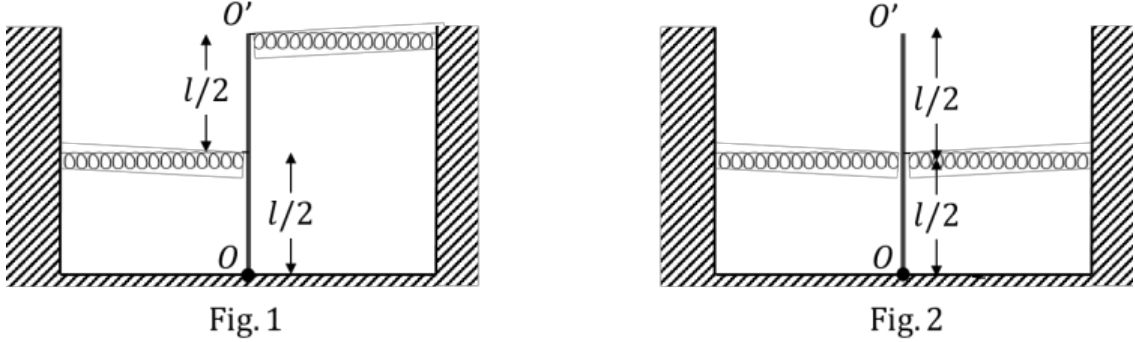
As shown in the figures, a uniform rod of length is hinged at the point and held in place vertically between two walls using two massless springs of same spring constant. The springs are connected at the midpoint and at the top-end () of the rod, as shown in Fig. 1 and the rod is made to oscillate by a small angular displacement. The frequency of oscillation of the rod is . On the other hand, if both the springs are connected at the midpoint of the rod, as shown in Fig. 2 and the rod is made to oscillate by a small angular displacement, then the frequency of oscillation is . Ignoring gravity and assuming motion only in the plane of the diagram, the value of is:
Options
Topics & Concepts
Step-by-Step Solution
To find the ratio of the frequencies of small angular oscillations , we analyze the restoring torques acting on the rod for both configurations.
Let:
- be the mass of the uniform rod ,
- be the length of the rod,
- be the spring constant of each spring,
- be a small angular displacement of the rod from its vertical equilibrium position.
The moment of inertia of the uniform rod about the hinge at its end is:
Case 1: Figure 1
When the rod is rotated clockwise by a small angle :
-
Spring at midpoint ():
- The linear displacement of the midpoint is .
- The spring connected to the left wall is stretched, exerting a leftward restoring force .
- The restoring torque about is:
-
Spring at top-end ():
- The linear displacement of the top-end is .
- The spring connected to the right wall is compressed, exerting a leftward restoring force .
- The restoring torque about is:
The total restoring torque for Fig. 1 is:
Using the rotational equation of motion :
Hence, the frequency of oscillation is:
Case 2: Figure 2
In this configuration, both springs are attached at the midpoint ():
- Upon displacement , the midpoint moves by .
- The left spring is stretched by , and the right spring is compressed by . Both springs apply restoring forces in the same direction (towards the left).
- The restoring force from each spring is .
The total restoring torque about for Fig. 2 is:
Using the equation of motion :
Hence, the frequency of oscillation is:
Ratio of Frequencies
Thus, the correct option is C.