Force Between Two Hemispherical Shells of Uniformly Charged Spherical Shell
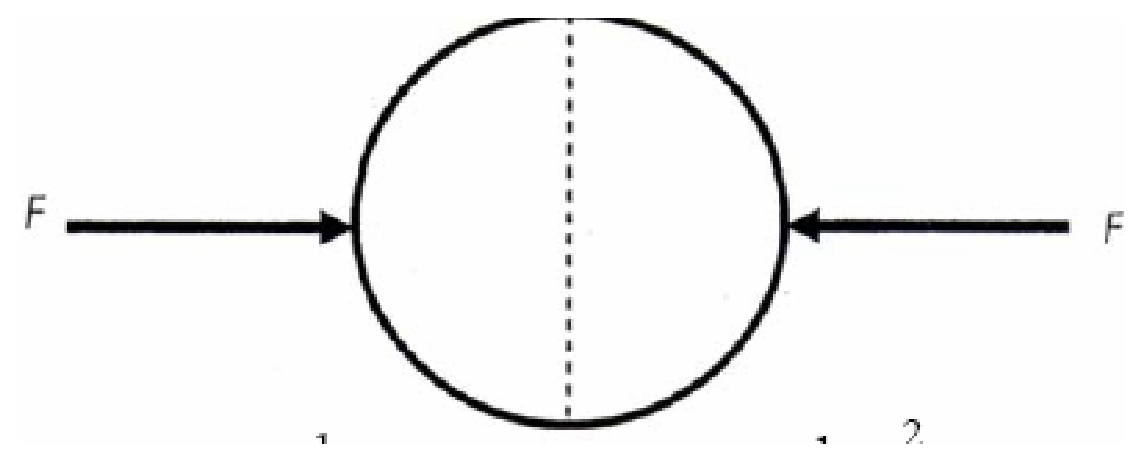
A uniformly charged thin spherical shell of radius carries uniform surface charge density of per unit area. It is made of two hemispherical shells, held together by pressing them with force (see figure). is proportional to
Options
Topics & Concepts
Step-by-Step Solution
To determine the force required to hold the two hemispherical shells together, we calculate the net electrostatic repulsive force exerted by the charged shell on one of its hemispheres.
The electrostatic pressure acting outward on the surface of a uniformly charged thin spherical shell with surface charge density is given by:
Consider one of the hemispherical shells with its symmetry axis oriented along the -axis. The element of surface area on the spherical surface at an angle with respect to the -axis is:
The component of electrostatic force acting on this area element along the -axis (the axis along which the force is applied) is:
Integrating over the entire hemisphere ( going from to ):
Evaluating the integral:
Substituting this back into the expression for :
Alternatively, using the concept of projected area, the total force due to uniform pressure along the axis of symmetry is equal to the pressure multiplied by the projected area of the hemisphere ():
To keep the two hemispherical shells together, the applied force must balance this electrostatic repulsive force:
Thus, the force is proportional to:
Correct Option: A