Find Maximum Angular Velocity of Ball in Conical Pendulum
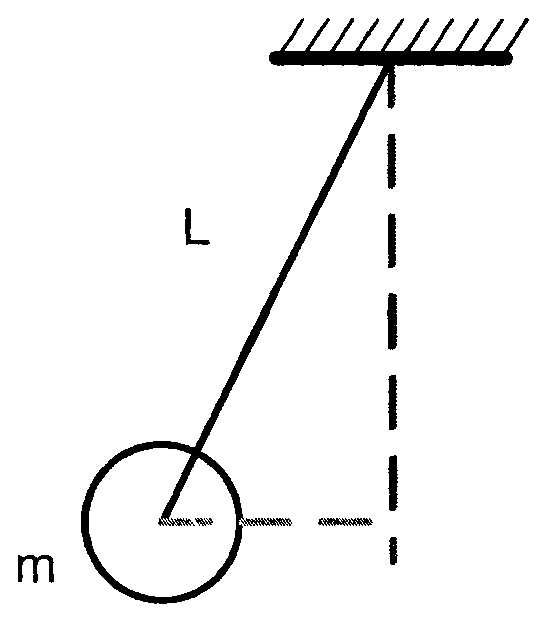
A ball of mass (m) is attached to the end of a string having length (L) . The ball is rotated on a horizontal circular path about vertical axis. The maximum tension that the string can bear is . The maximum possible value of angular velocity of ball (in radian/s) is
Options
9
18
27
36
Topics & Concepts
Step-by-Step Solution
To find the maximum possible angular velocity of the ball, we analyze the forces acting on the ball of mass executing circular motion in a conical pendulum setup.
Let be the angle made by the string of length with the vertical axis.
The forces acting on the ball are:
- The tension along the length of the string pointing towards the point of suspension.
- The gravitational force acting vertically downwards.
Resolving the tension into vertical and horizontal components:
- Vertical component:
- Horizontal component:
Since the ball moves in a horizontal circular path of radius :
-
For vertical equilibrium:
-
The horizontal component provides the necessary centripetal force for circular motion:
Substituting :
Assuming (the pendulum is swung out into a circle):
From Equation (2), the angular velocity is given by:
To obtain the maximum possible angular velocity , the tension must reach its maximum allowable value .
Given values:
- Mass of the ball,
- Length of the string,
- Maximum tension,
Substituting these values into the expression for :
(Note: The condition is satisfied, ensuring a valid physical configuration.)
Therefore, the maximum possible value of the angular velocity is .
Correct Option: (D) 36