Find initial linear speed of rolling disc on curved surface
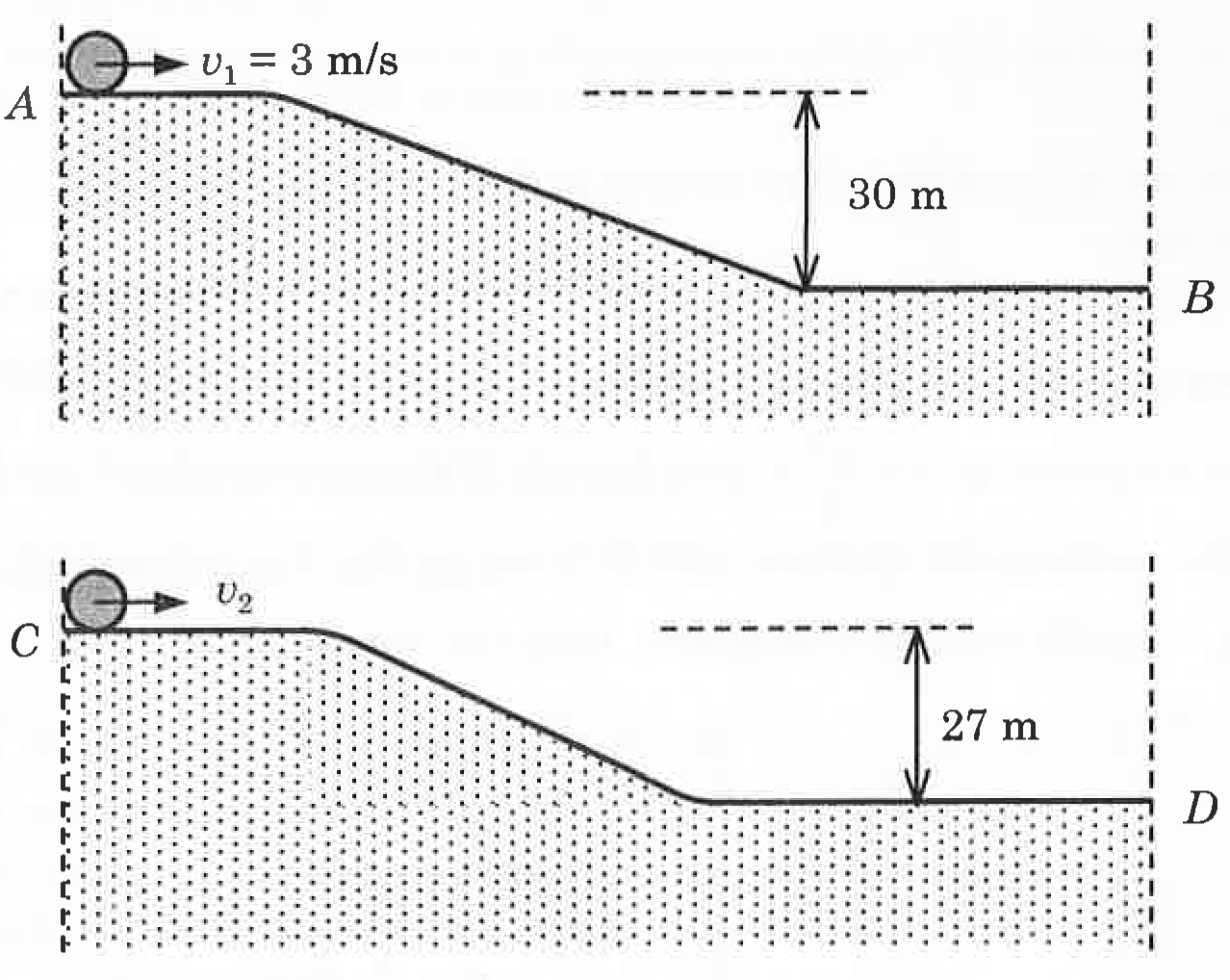
Two identical uniform discs roll without slipping on two distinct surfaces and (refer to figure) starting from points and with initial linear speeds and , respectively, while constantly maintaining contact with the surfaces. If both discs reach points and with identical linear speeds and , the value of in is (take ):
Topics & Concepts
Step-by-Step Solution
To find the initial linear speed of the second disc, we use the principle of conservation of mechanical energy for rolling without slipping.
Since both discs roll without slipping, static friction acts at the point of contact, which does no work. Therefore, mechanical energy is conserved for both discs.
For a uniform disc of mass and radius , its moment of inertia about its center of mass is:
Since the disc rolls without slipping, its angular velocity is related to its linear velocity by . The total kinetic energy of a rolling disc is the sum of its translational and rotational kinetic energies:
Let be the identical final linear speed of both discs at points and .
-
For the disc moving on track : The drop in vertical height is . Applying conservation of mechanical energy:
-
For the disc moving on track : The drop in vertical height is . Applying conservation of mechanical energy:
Equating the two expressions for the final energy at points and :
Canceling mass from both sides and rearranging:
Substituting the given values (, , , ):