Find Constant Value for Magnetic Field of Rotating Charged Cone
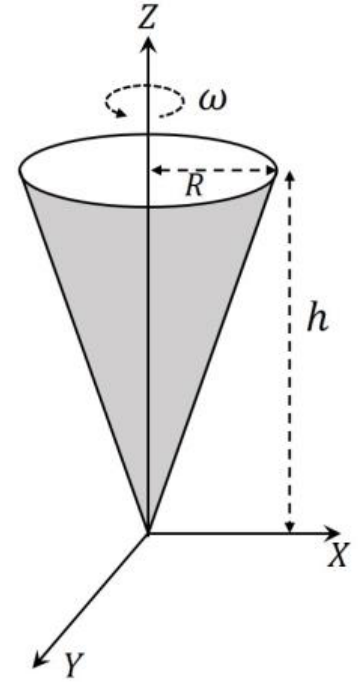
A hollow, right circular cone of base radius and height , with its tip at the origin is rotating about the -axis with an angular velocity , as shown in the figure. The cone carries a total charge uniformly distributed on its curved surface. The magnitude of magnetic field at a point , where and , is . The value of is:
Topics & Concepts
Step-by-Step Solution
To find the magnitude of the magnetic field at a point along the axis of the rotating cone where and , we can treat the rotating cone as a magnetic dipole with a total magnetic dipole moment .
Step 1: Charge distribution on the cone
Let the apex of the hollow, right circular cone be at the origin and its axis lie along the -axis. At a distance along the axis from the origin (), the radius of the circular cross-section is:
The slant height of the cone is . The total surface area of the curved surface is:
Since the total charge is uniformly distributed over the surface, the surface charge density is:
Consider a thin circular ring element on the cone's surface at position of width along the slant height . The charge on this ring element is given by:
Step 2: Magnetic Moment of the Cone
As the cone rotates about the -axis with angular velocity , the ring element forms an effective current :
The magnetic dipole moment due to this differential ring element of area is:
Integrating over the entire height of the cone from to :
Step 3: Magnetic Field along the Axis
At a far point on the axis where and , the magnetic field is given by the axial magnetic field formula of a dipole:
Substituting the expression for :
Comparing this with the given expression:
We find the value of to be: