Final Speed of Object After Successive Elastic and Inelastic Collisions
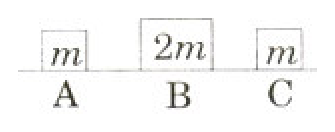
Three objects A, B and C are kept in a straight line on a frictionless horizontal surface. These have masses , and , respectively. The object A moves towards B with a speed and makes an elastic collision with it. Thereafter, B makes completely inelastic collision with C. All motions occur on the same straight line. Find the final speed () of the object C.
Topics & Concepts
Step-by-Step Solution
To find the final speed of object C, we analyze the problem in two stages of collisions occurring along the straight line on the frictionless horizontal surface.
Stage 1: Elastic collision between object A and object B
- Mass of object A:
- Mass of object B:
- Initial velocity of object A:
- Initial velocity of object B:
Since the collision is perfectly elastic (), linear momentum and kinetic energy are conserved. The velocity of object B immediately after the collision, , is given by the standard elastic collision formula:
Substituting the given values into the formula:
Stage 2: Completely inelastic collision between object B and object C
- Mass of object B:
- Velocity of object B before collision:
- Mass of object C:
- Velocity of object C before collision:
Since the collision between B and C is completely inelastic, the two objects stick together and move with a common final velocity .
Applying the law of conservation of linear momentum for the system consisting of B and C:
Substitute the given values:
Since object C moves together with object B after the collision, the final speed of object C is .