Expression for Reflected Wave at Brewster Angle
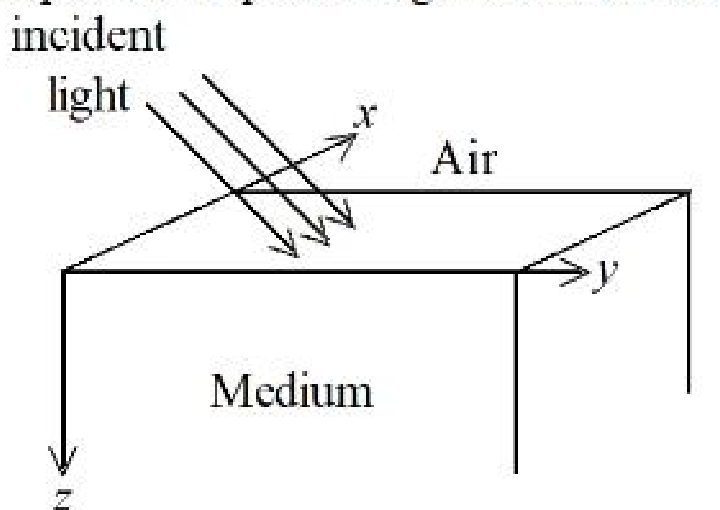
An unpolarized light is incident on the plane interface of air-dielectric medium shown in figure. If the incident angle is equal to Brewster angle, identify the expression representing reflected wave.
Options
Topics & Concepts
Step-by-Step Solution
To identify the correct expression representing the reflected wave, we analyze the propagation vector and the polarization state of the wave:
1. Determination of Wave Vector and Phase Factor
From the given diagram:
- The plane interface separating air and the dielectric medium lies in the -plane ().
- Air lies in the region , while the dielectric medium lies in .
- The plane of incidence is defined by the incident wave vector and the normal to the boundary (-axis), which is the -plane.
- The incident light travels in air towards the interface, having positive velocity components along both the and directions. Thus, its wave vector is:
Upon reflection at the plane interface :
- The parallel component of the wave vector (-component) remains unchanged: .
- The normal component (-component) reverses its direction as the wave reflects back into air (): .
- Therefore, the reflected wave vector is:
Assuming , the spatial phase part of the wave equation becomes:
2. Polarization at Brewster's Angle
-
When unpolarized light is incident at Brewster's angle, the reflected wave becomes completely linearly polarized with its electric field vector oscillating perpendicular to the plane of incidence (s-polarization).
-
Since the plane of incidence is the -plane, the direction perpendicular to it is along the -axis ().
-
Furthermore, for a transverse electromagnetic wave, the electric field vector must be perpendicular to the direction of propagation ().
For and :
Thus, the electric field vector is purely along the -direction (), perfectly consistent with s-polarization at Brewster's angle.
Conclusion
Combining the polarization state and the phase term, the expression for the reflected wave is:
Correct Answer: A