Equilibrium Volume of Compartment with Movable Conducting Partition
A closed container consists of two compartments and , both filled with oxygen (treated as an ideal gas). Initially, the separating partition is rigidly fixed and serves as a perfect thermal insulator (Figure 1). If this partition is replaced by a movable, heat-conducting wall that does NOT permit gas to pass through (Figure 2), determine the equilibrium volume (in ) of compartment .
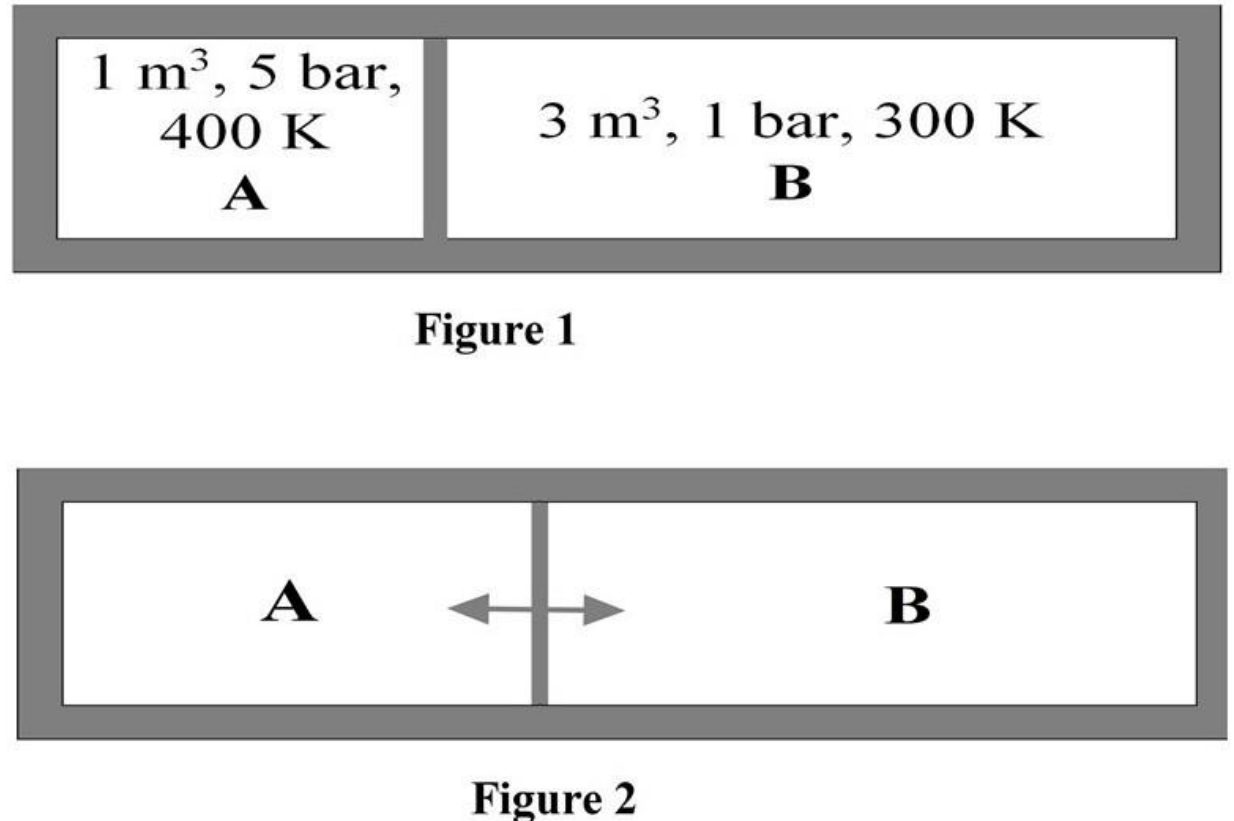
Topics & Concepts
Step-by-Step Solution
To find the equilibrium volume of compartment , we use the ideal gas law and the conditions for thermal and mechanical equilibrium.
Step 1: Calculate the initial moles of gas in each compartment
Using the ideal gas equation , we determine the number of moles in compartments and :
-
For compartment :
-
For compartment :
The total volume of the closed container is:
Step 2: Establish the equilibrium conditions
When the partition is replaced by a movable, heat-conducting wall:
- Thermal equilibrium ensures that the final temperature in both compartments is the same:
- Mechanical equilibrium ensures that the final pressure in both compartments is the same:
Step 3: Relate volumes to the number of moles
For the two compartments at equilibrium:
Dividing the two equations gives:
Substitute the values of and :
Thus,
Step 4: Solve for
Since the total volume remains constant:
The equilibrium volume of compartment is (or ).