Equilibrium and Tension in Hinged Uniform Beam with Suspended Mass
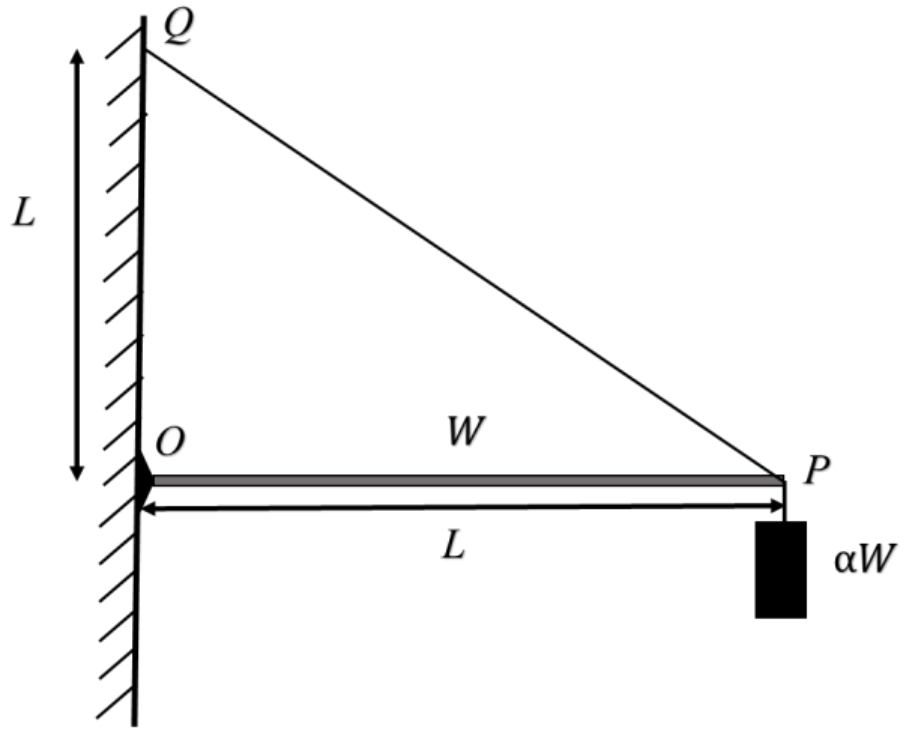
One end of a horizontal uniform beam of weight and length is hinged on a vertical wall at point , while its opposite end is supported by a light inextensible rope. The upper end of the rope is attached at point , located at a height vertically above the hinge at point . A block of weight is attached at point of the beam, as depicted in the figure (not to scale). The rope can withstand a maximum tension of . Which of the following statement(s) is(are) correct?
Options
The vertical component of reaction force at does not depend on
The horizontal component of reaction force at is equal to for
The tension in the rope is for
The rope breaks if
Topics & Concepts
Step-by-Step Solution
To determine which statements are correct, we analyze the static equilibrium of the horizontal beam.
1. Geometry of the System
Let the hinge at point be the origin .
- Point , where the block is suspended, is at .
- Point , where the upper end of the rope is fixed, is at .
The angle that the rope makes with the horizontal beam is given by:
Thus, .
2. Forces Acting on the Beam
The forces acting on the beam are:
- Weight of the beam , acting downward at its center of mass .
- Weight of the block , acting downward at point .
- Tension in the rope acting along at point :
- Horizontal component: (towards the left)
- Vertical component: (upward)
- Hinge reaction force at :
- Horizontal component:
- Vertical component:
3. Rotational Equilibrium
Taking the torque about the hinge to be zero ():
Dividing by :
Solving for tension :
4. Translational Equilibrium
Horizontal Direction ():
Substituting :
Vertical Direction ():
Substituting :
Notice that is a constant and does not depend on .
5. Analysis of Options
-
Option A: The vertical component of reaction force at is , which is independent of .
Statement A is correct. -
Option B: For :
Statement B is correct. -
Option C: For :
Statement C is incorrect. -
Option D: The maximum tension the rope can sustain is .
The rope breaks when :
Statement D is correct.
Conclusion
The correct statements are A, B, and D.