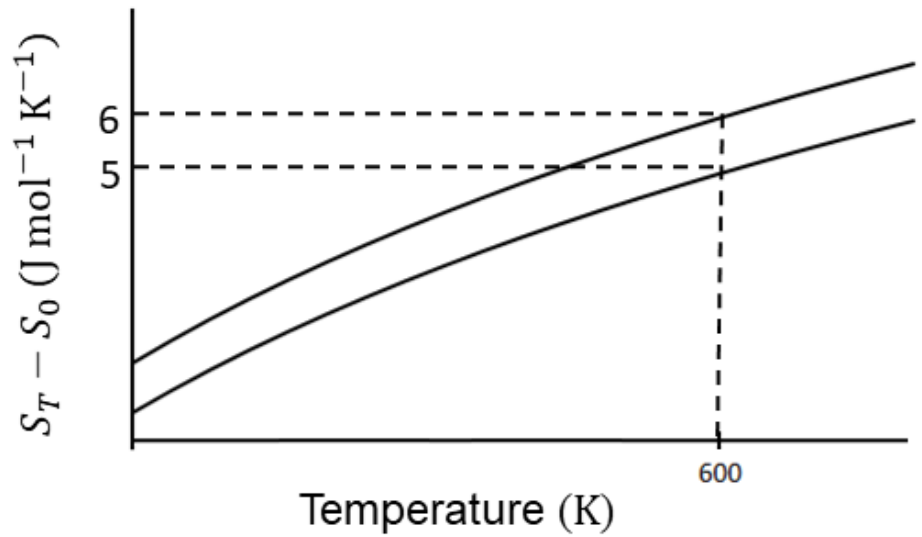
To find the value of the enthalpy change, Hβ−Hα, at T=300 K, we can follow these steps:
Step 1: Calculate the entropy change of phase transition at 600 K
According to the Third Law of Thermodynamics, for perfectly crystalline substances, the entropy at 0 K is zero:
S0,α=S0,β=0 J mol−1 K−1
From the given plot at the phase transition temperature Ttrans=600 K:
- For the β phase: S600,β−S0,β=6 J mol−1 K−1⟹Sβ(600 K)=6 J mol−1 K−1
- For the α phase: S600,α−S0,α=5 J mol−1 K−1⟹Sα(600 K)=5 J mol−1 K−1
Thus, the entropy change for the phase transition α→β at 600 K is:
ΔStrans(600 K)=Sβ(600 K)−Sα(600 K)=6−5=1 J mol−1 K−1
Step 2: Calculate the enthalpy change of phase transition at 600 K
At the transition temperature Ttrans=600 K, the two phases are in thermodynamic equilibrium (ΔGtrans=0):
ΔGtrans(600 K)=ΔHtrans(600 K)−Ttrans⋅ΔStrans(600 K)=0
ΔHtrans(600 K)=Ttrans⋅ΔStrans(600 K)
ΔHtrans(600 K)=600 K×1 J mol−1 K−1=600 J mol−1
Step 3: Calculate the enthalpy change at 300 K using Kirchhoff's Law
Using Kirchhoff's equation for the temperature dependence of the enthalpy change:
ΔH(600 K)−ΔH(300 K)=∫300600ΔCpdT
where ΔCp=Cp,β−Cp,α=1 J mol−1 K−1 (given to be independent of temperature).
Integrating gives:
ΔH(600 K)−ΔH(300 K)=ΔCp⋅(600−300)
600−ΔH(300 K)=1 J mol−1 K−1×(600−300) K
600−ΔH(300 K)=300 J mol−1
ΔH(300 K)=600−300=300 J mol−1
Thus, the value of the enthalpy change Hβ−Hα at 300 K is 300.