Electrophilic Aromatic Nitration of Benzanilide
In the following reaction,
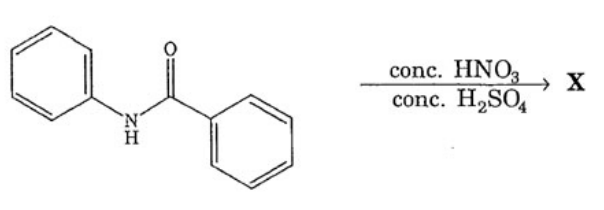
the structure of the major product '' is
Options
A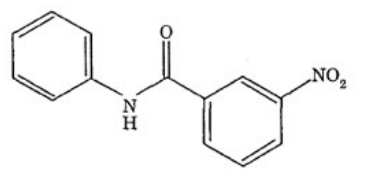
B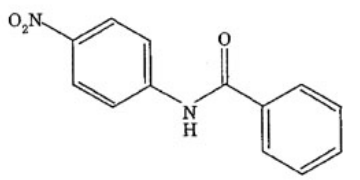 Correct
C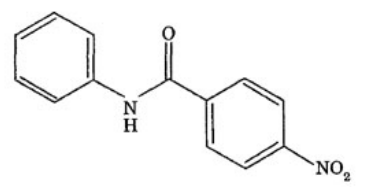
D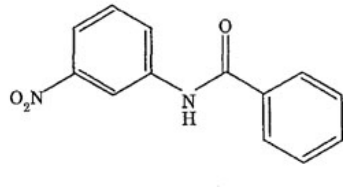
Topics & Concepts
Step-by-Step Solution
To determine the major product '' of the given electrophilic aromatic substitution reaction, we analyze the reactivity of the two aromatic rings present in benzanilide ():
-
Comparison of Ring Reactivities:
- Ring A (attached to the nitrogen atom, ): The nitrogen atom possesses a lone pair of electrons that can be delocalized into Ring A via a positive mesomeric effect ( / ). Although this electron density is partially shared with the adjacent carbonyl group, the group remains overall activating towards electrophilic aromatic substitution compared to benzene.
- Ring B (attached to the carbonyl group, ): The carbonyl carbon is electron-deficient and withdraws electron density from Ring B via a negative mesomeric effect ( / ) and a negative inductive effect (). Thus, Ring B is strongly deactivated towards electrophilic aromatic substitution.
-
Site of Electrophilic Attack:
- The nitronium ion (), which is the electrophile generated by the mixture of concentrated and concentrated , attacks the more electron-rich ring, which is Ring A.
-
Regioselectivity (Ortho vs. Para):
- The group is an ortho/para-directing group.
- Because the group is relatively bulky, electrophilic attack at the ortho-position is sterically hindered.
- Consequently, substitution occurs predominantly at the less hindered para-position of Ring A.
Therefore, the major product is (), in which the nitro group () is attached para to the group.
This corresponds to the structure shown in option (B).
Correct Answer: (B)