Electric Potential Due to Dipole Shifted in XY Plane
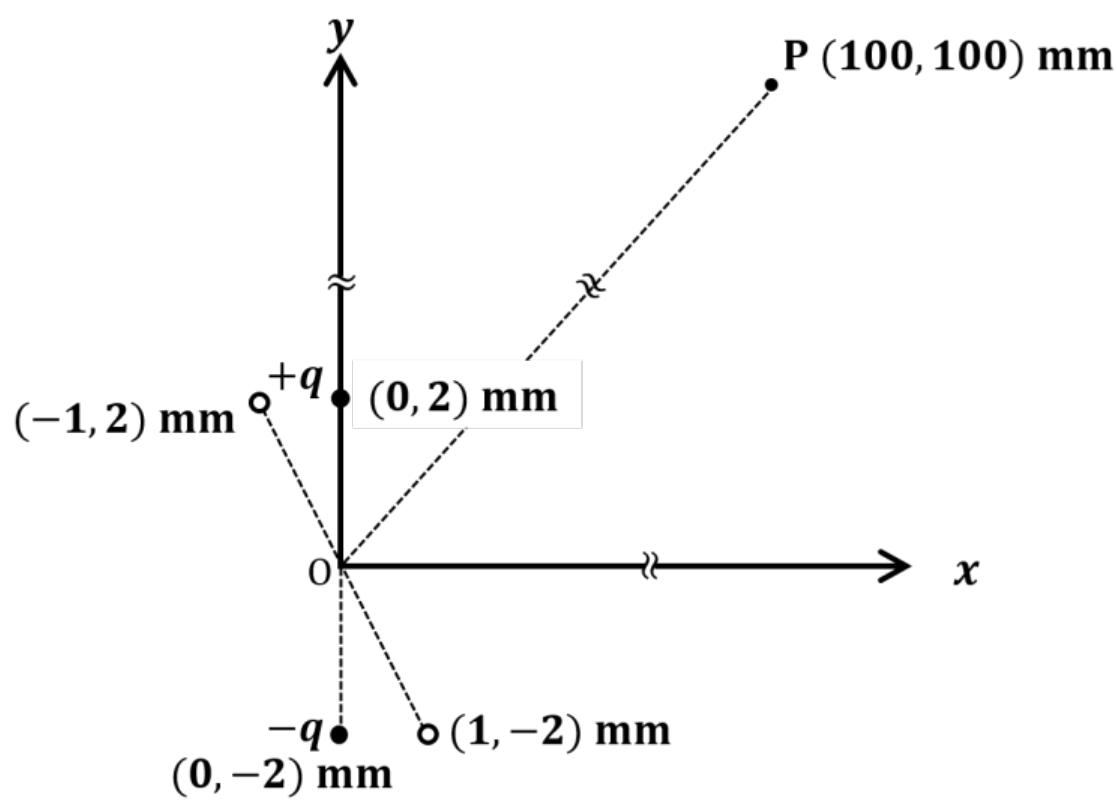
An electric dipole is formed by two charges +q and −q located in xy-plane at (0,2) mm and (0,−2) mm, respectively, as shown in the figure. The electric potential at point P (100,100) mm due to the dipole is V0. The charges +q and −q are then moved to the points (−1,2) mm and (1,−2) mm, respectively. What is the value of electric potential at P due to the new dipole?
To find the electric potential at point P due to the new dipole configuration, we can use the expression for the electric potential due to a short dipole at a distance r≫d (where d is the dipole length).
The electric potential V at a position vector r relative to the center of a dipole with dipole moment p is given by:
V=4πε01r3p⋅r
Step 1: Initial Dipole Configuration
The initial positions of the charges are:
Charge +q at (0,2) mm
Charge −q at (0,−2) mm
The center of this dipole is at the origin (0,0) mm.
The initial dipole moment vector p1 is directed from −q to +q:
p1=q[(0−0)i^+(2−(−2))j^]=4qj^ mm⋅C
The position vector of point P relative to the origin is:
rP=100i^+100j^ mm
The dot product p1⋅rP is:
p1⋅rP=(4qj^)⋅(100i^+100j^)=400q mm2⋅C
Therefore, the initial potential V0 at point P is proportional to p1⋅rP:
V0=4πε01rP3400q
Step 2: New Dipole Configuration
The new positions of the charges are:
Charge +q moved to (−1,2) mm
Charge −q moved to (1,−2) mm
The center of the new dipole remains at the origin (2−1+1,22−2)=(0,0) mm.
The new dipole moment vector p2 is:
p2=q[(−1−1)i^+(2−(−2))j^]=(−2i^+4j^)q mm⋅C
The dot product p2⋅rP is:
p2⋅rP=(−2qi^+4qj^)⋅(100i^+100j^)=−200q+400q=200q mm2⋅C
Step 3: Ratio of Potentials
The new electric potential V′ at point P is:
V′=4πε01rP3p2⋅rP
Taking the ratio of V′ to V0:
V0V′=p1⋅rPp2⋅rP=400q200q=21
Thus, the potential at point P due to the new dipole is:
V′=2V0