Electric Flux Through Rectangular Surface from Line Charge
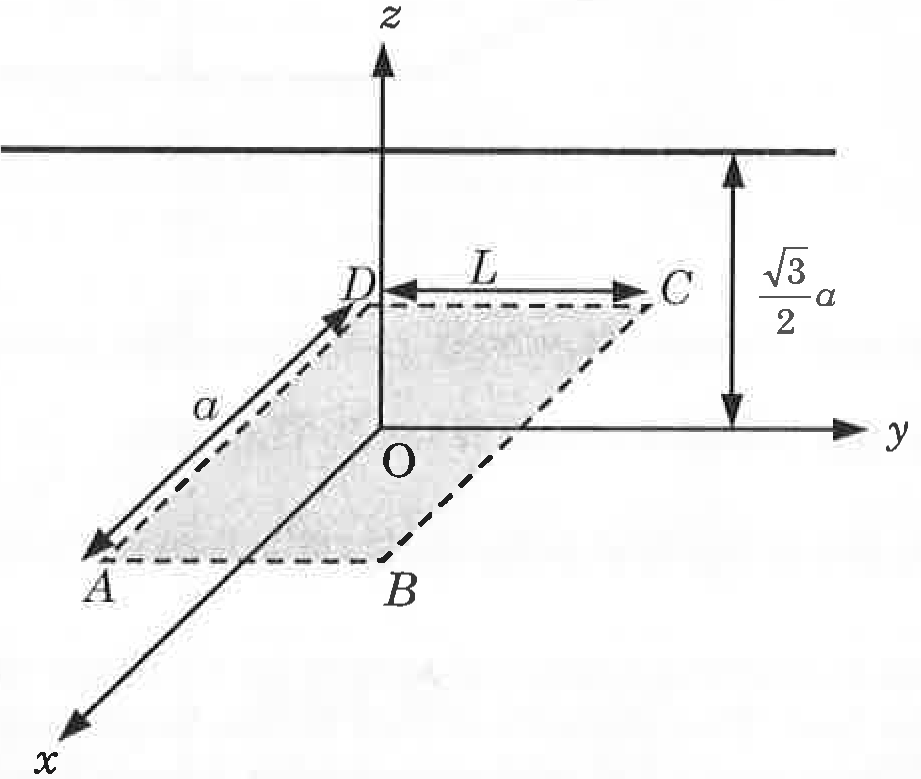
A very long line charge distribution of charge per unit length lies parallel to the -axis in the - plane at (see illustration). If the magnitude of the electric field flux through the rectangular planar surface located in the - plane with its centre at origin is (where represents permittivity of free space), determine the value of .
Topics & Concepts
Step-by-Step Solution
To find the magnitude of the electric flux through the rectangular surface , we analyze the geometry of the system in the - plane perpendicular to the line charge.
1. Geometry and Coordinate Setup
- Line Charge: Lies parallel to the -axis at and . Thus, its cross-sectional position in the - plane is .
- Rectangular Surface : Lying in the - plane () centered at the origin , with length along the -axis (from to ) and width along the -axis (from to ).
2. Angle Subtended by the Surface
Consider the cross-section of the surface in the - plane, which is represented by the line segment from to .
Let be the angle subtended by this segment at the location of the line charge . Using trigonometry for the right triangle formed by the origin, , and :
This gives:
3. Calculating the Electric Flux using Gauss's Law
For an infinitely long line charge with charge density , the electric field is directed radially outward from the line.
If we construct a coaxial cylindrical Gaussian surface of radius and length centered around the line charge, the total electric flux passing through its curved surface of length is given by Gauss's Law:
Since the electric field has cylindrical symmetry, the flux through any longitudinal section of length that subtends an angle at the line charge is directly proportional to the fraction of the total radians it subtends:
Substituting and :
4. Comparison and Conclusion
Comparing the derived expression for the flux with the given expression:
We find: