JEE Challenger
More from Electric Charges and Fields

Electric Flux Through Parallel Plane Between Coaxial Cylinders with Dielectric

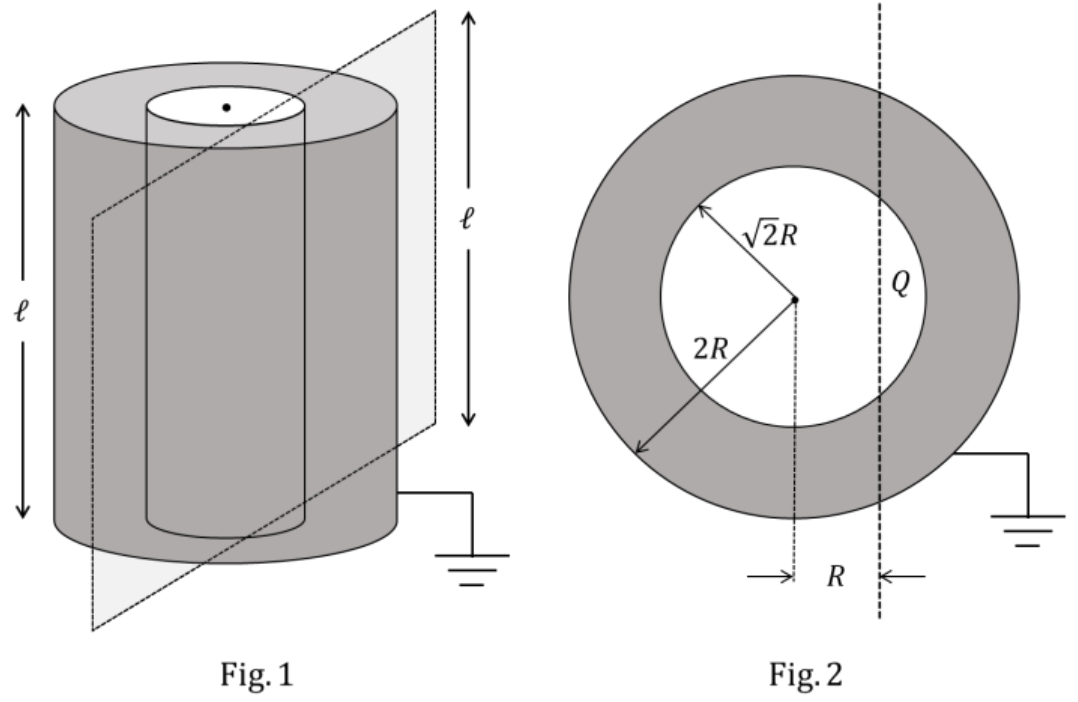
Two co-axial conducting cylinders of same length \ell with radii 2R\sqrt{2}R and 2R2R are kept, as shown in Fig. 1. The charge on the inner cylinder is QQ and the outer cylinder is grounded. The annular region between the cylinders is filled with a material of dielectric constant κ=5\kappa = 5. Consider an imaginary plane of the same length \ell at a distance RR from the common axis of the cylinders. This plane is parallel to the axis of the cylinders. The cross-sectional view of this arrangement is shown in Fig. 2. Ignoring edge effects, the flux of the electric field through the plane is (ϵ0\epsilon_0 is the permittivity of free space):

Question Diagram 1

Options

A

Q30ϵ0\frac{Q}{30\epsilon_0}

B

Q15ϵ0\frac{Q}{15\epsilon_0}

C

Q60ϵ0\frac{Q}{60\epsilon_0}

Correct
D

Q120ϵ0\frac{Q}{120\epsilon_0}

Step-by-Step Solution

To find the flux of the electric field through the imaginary plane, we proceed step-by-step using Gauss's Law and surface integration.

Step 1: Electric Field in the Dielectric Region

The system consists of two coaxial conducting cylinders of length \ell. The inner cylinder has a radius r1=2Rr_1 = \sqrt{2}R and carries a charge QQ. The outer cylinder has a radius r2=2Rr_2 = 2R and is grounded. The region between r1r_1 and r2r_2 is filled with a dielectric material of relative permittivity κ=5\kappa = 5.

By Gauss's law for the electric displacement field D\vec{D} in cylindrical coordinates: DdA=Qfree\oint \vec{D} \cdot d\vec{A} = Q_{\text{free}} D(2πr)=Q    D(r)=Q2πrD(2\pi r \ell) = Q \implies D(r) = \frac{Q}{2\pi r \ell}

Since D=κϵ0E\vec{D} = \kappa \epsilon_0 \vec{E}, the electric field in the annular dielectric region (2Rr2R\sqrt{2}R \le r \le 2R) is: E(r)=Q2πκϵ0rr^\vec{E}(r) = \frac{Q}{2\pi \kappa \epsilon_0 \ell r} \hat{r}

For r<2Rr < \sqrt{2}R (inside the inner conductor) and r>2Rr > 2R (outside the grounded outer cylinder), the electric field E=0\vec{E} = 0.

Step 2: Parametrizing the Plane

Set up a Cartesian coordinate system with the origin at the center of the cross-section along the common axis:

  • The common axis is along the zz-axis (0z0 \le z \le \ell).
  • The plane is parallel to the axis at a distance RR from it, so its equation is x=Rx = R.

The distance rr from any point (R,y,z)(R, y, z) on the plane to the axis is: r=x2+y2=R2+y2r = \sqrt{x^2 + y^2} = \sqrt{R^2 + y^2}

The normal to the plane is in the direction of i^\hat{i}, so the area element is dA=dydzi^d\vec{A} = dy \, dz \, \hat{i}.

The component of the electric field normal to the plane is: Ex=Ei^=E(r)cosθ=E(r)xr=Q2πκϵ0rRr=QR2πκϵ0(R2+y2)E_x = \vec{E} \cdot \hat{i} = E(r) \cos\theta = E(r) \frac{x}{r} = \frac{Q}{2\pi \kappa \epsilon_0 \ell r} \frac{R}{r} = \frac{Q R}{2\pi \kappa \epsilon_0 \ell (R^2 + y^2)}

Step 3: Determining the Limits of Integration

The electric field is non-zero only within the dielectric region where 2Rr2R\sqrt{2}R \le r \le 2R: (2R)2R2+y2(2R)2(\sqrt{2}R)^2 \le R^2 + y^2 \le (2R)^2 2R2R2+y24R22R^2 \le R^2 + y^2 \le 4R^2 R2y23R2R^2 \le y^2 \le 3R^2

This yields two symmetric segments for yy: y[3R,R]andy[R,3R]y \in [-\sqrt{3}R, -R] \quad \text{and} \quad y \in [R, \sqrt{3}R]

Step 4: Calculating the Total Flux

The total flux Φ\Phi through the plane is given by the integral of ExE_x over the area of the plane where E0\vec{E} \neq 0: Φ=z=0dzyregionExdy\Phi = \int_{z=0}^{\ell} dz \int_{y \in \text{region}} E_x \, dy

Φ=QR2πκϵ0[2R3RdyR2+y2]\Phi = \ell \cdot \frac{Q R}{2\pi \kappa \epsilon_0 \ell} \left[ 2 \int_{R}^{\sqrt{3}R} \frac{dy}{R^2 + y^2} \right]

Evaluating the definite integral: R3RdyR2+y2=[1Rarctan(yR)]R3R=1R(arctan(3)arctan(1))\int_{R}^{\sqrt{3}R} \frac{dy}{R^2 + y^2} = \left[ \frac{1}{R} \arctan\left(\frac{y}{R}\right) \right]_{R}^{\sqrt{3}R} = \frac{1}{R} \left( \arctan(\sqrt{3}) - \arctan(1) \right)

R3RdyR2+y2=1R(π3π4)=π12R\int_{R}^{\sqrt{3}R} \frac{dy}{R^2 + y^2} = \frac{1}{R} \left( \frac{\pi}{3} - \frac{\pi}{4} \right) = \frac{\pi}{12R}

Substituting this back into the flux equation: Φ=QR2πκϵ02(π12R)=Q12κϵ0\Phi = \frac{Q R}{2\pi \kappa \epsilon_0} \cdot 2 \cdot \left( \frac{\pi}{12R} \right) = \frac{Q}{12 \kappa \epsilon_0}

Given κ=5\kappa = 5: Φ=Q12×5ϵ0=Q60ϵ0\Phi = \frac{Q}{12 \times 5 \epsilon_0} = \frac{Q}{60\epsilon_0}

Correct Answer: C (Q60ϵ0\frac{Q}{60\epsilon_0})

Electric Flux Through Parallel Plane Between Coaxial Cylinders with Dielectric | Physics PYQ Solution - JEE Challenger