Electric Field and Potential of Three Charges on Circle
Consider a system of three charges and placed at points A, B and C, respectively, as shown in the figure. Take O to be the centre of the circle of radius and angle
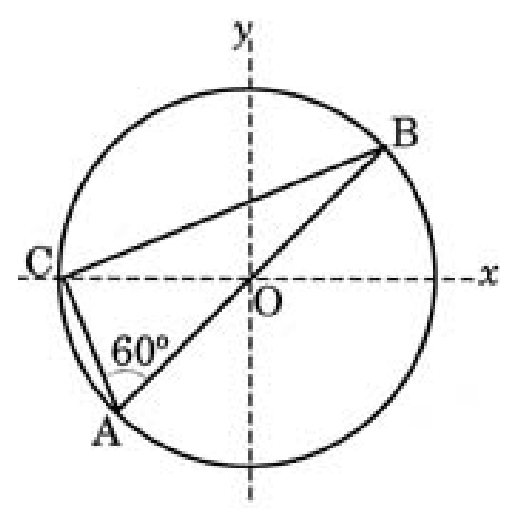
Options
The electric field at point O is directed along the negative x-axis
The potential energy of the system is zero
The magnitude of the force between the charges at C and B is
The potential at point O is
Step-by-Step Solution
To determine the correct option, we analyze the given system of charges using geometric and electrostatic principles.
1. Distance Between Charges at and
The three points , , and lie on a circle of radius centered at .
The angle subtended by the chord at the point on the circumference is given as:
By the inscribed angle theorem, the angle subtended by the arc at the center is twice the angle subtended at the circumference:
Now, considering triangle , where and , we apply the Law of Cosines to find the distance :
2. Force Between Charges at and
The charges placed at points and are:
Using Coulomb's Law, the magnitude of the electrostatic force between the charges at and is:
Substitute the values of , , and :
This matches statement (C).
3. Verification of Other Options
-
Electric Potential at Point (Option D):
Hence, Option D is incorrect. -
Potential Energy of the System (Option B):
The potential energy depends on the pairwise distances . Since the net potential energy is generally non-zero, Option B is incorrect. -
Electric Field at Point (Option A):
The vector sum of electric fields depends on the explicit position vectors of , which are not given to yield a net magnitude of along the negative x-axis in general.
Thus, the correct statement is C.