Electric Field and Potential of Hexagonal Charge Configuration
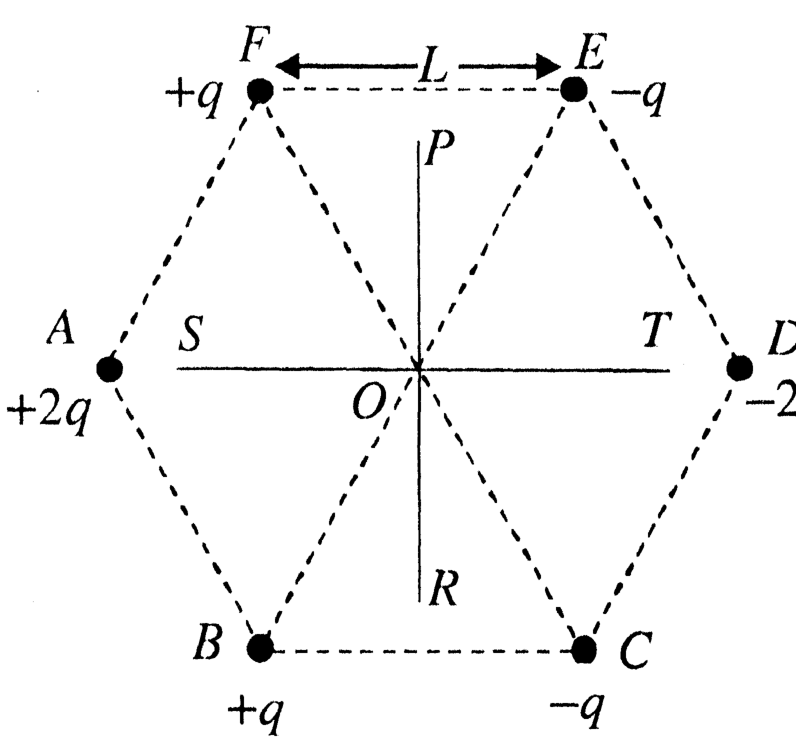
Six point charges are arranged at the vertices of a regular hexagon with side length L and center at O, as illustrated in the diagram. Given K=4πε01L2q, select the correct statement(s):
Options
A
The electric field at O equals 6K directed along OD.
Correct
B
The electrostatic potential at O is zero.
Correct
C
The potential remains identical across all points on line PR.
Correct
D
The potential remains identical across all points on line ST.
To determine the correct statements, let us set up a Cartesian coordinate system with the origin at the center O of the regular hexagon. Let the line AD lie along the x-axis.
The distance from the center O to any vertex of a regular hexagon with side length L is equal to L.
The coordinates and charges at the six vertices are:
A:(−L,0) with charge qA=+2q
B:(−2L,−23L) with charge qB=+q
C:(2L,−23L) with charge qC=−q
D:(L,0) with charge qD=−2q
E:(2L,23L) with charge qE=−q
F:(−2L,23L) with charge qF=+q
1. Evaluation of Statement (A): Electric Field at O
The electric field at O(0,0) due to a charge qi located at ri is given by:
Ei=4πε01ri2qi(−r^i)
Given K=4πε01L2q:
Field due to pair A and D:
Charge +2q at A creates a field at O directed along +i^ with magnitude 4πε01L22q=2K.
Charge −2q at D creates a field at O directed along +i^ with magnitude 4πε01L22q=2K.
EAD=(2K+2K)i^=4Ki^
Field due to pair B and E:
Charge +q at B creates a field at O directed towards E (at an angle of +60∘ with the +x-axis) with magnitude K.
Charge −q at E creates a field at O directed towards E with magnitude K.
EBE=2K(cos60∘i^+sin60∘j^)=2K(21i^+23j^)=Ki^+3Kj^
Field due to pair F and C:
Charge +q at F creates a field at O directed towards C (at an angle of −60∘ with the +x-axis) with magnitude K.
Charge −q at C creates a field at O directed towards C with magnitude K.
EFC=2K(cos(−60∘)i^+sin(−60∘)j^)=2K(21i^−23j^)=Ki^−3Kj^
Net Electric Field at O:EO=EAD+EBE+EFC=4Ki^+(Ki^+3Kj^)+(Ki^−3Kj^)=6Ki^
Since i^ is along the direction OD, the electric field at O is 6K along OD. Statement (A) is correct.
2. Evaluation of Statement (B): Potential at O
The electrostatic potential at the center O is the scalar sum of the potentials due to each point charge:
VO=4πε0L1∑iqi=4πε0L1[(+2q)+(+q)+(−q)+(−2q)+(−q)+(+q)]=0
Statement (B) is correct.
3. Evaluation of Statement (C): Potential on Line PR
The line PR is perpendicular to AD and passes through O, coinciding with the y-axis (x=0).
For any point (0,y) on the line PR:
Contribution from A and D:
Distance to A(−L,0) is rA=L2+y2.
Distance to D(L,0) is rD=L2+y2.
VAD(0,y)=4πε01(L2+y22q−L2+y22q)=0
Contribution from F and E:
Distance to F(−2L,23L) is rF=(2L)2+(y−23L)2.
Distance to E(2L,23L) is rE=(2L)2+(y−23L)2=rF.
VFE(0,y)=4πε01(rFq−rEq)=0
Contribution from B and C:
Distance to B(−2L,−23L) is rB=(2L)2+(y+23L)2.
Distance to C(2L,−23L) is rC=(2L)2+(y+23L)2=rB.
VBC(0,y)=4πε01(rBq−rCq)=0
Summing all contributions, the potential at any point on line PR is:
V(0,y)=VAD+VFE+VBC=0
Since V(0,y)=0 everywhere on PR, the potential remains constant (zero) across all points on line PR. Statement (C) is correct.
4. Evaluation of Statement (D): Potential on Line ST
The line ST lies along the x-axis (y=0). For a point (x,0) on ST:
VAD(x,0)=4πε01(∣x+L∣2q−∣x−L∣2q)=0
Since VAD(x,0) varies with x, the electrostatic potential is not identical across all points on ST. Statement (D) is incorrect.