Ease of Decarboxylation in Substituted Cyclohexane Derivatives
Which among the following organic compounds undergoes decarboxylation most easily under mild conditions?
Options
Step-by-Step Solution
To determine which compound undergoes decarboxylation most easily under mild conditions, we analyze the structural features and decarboxylation mechanisms of each given compound:
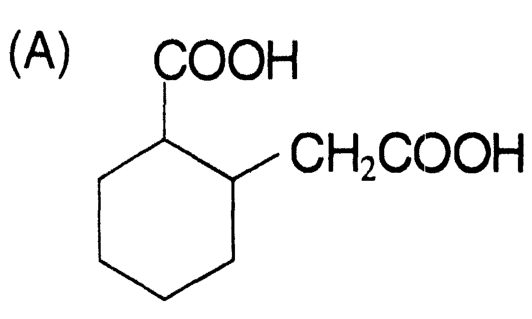
- Option (A) is a -dicarboxylic acid ( derivative).
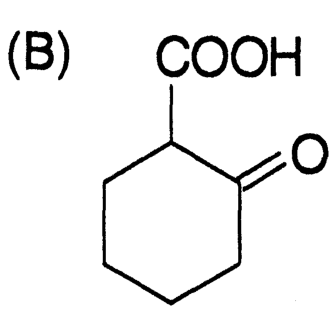
- Option (B) is a -keto acid (-oxocyclohexanecarboxylic acid), where a carbonyl group () is located at the position to the carboxylic acid group ().
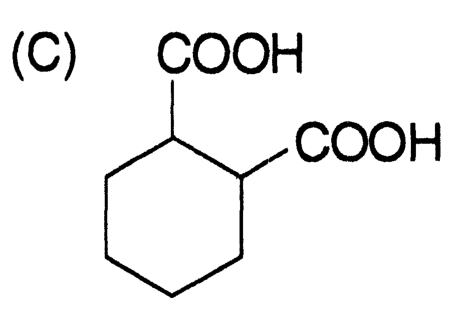
- Option (C) is a -dicarboxylic acid (-dicarboxylic acid system), which typically undergoes dehydration to form a cyclic anhydride upon heating rather than simple decarboxylation under mild conditions.
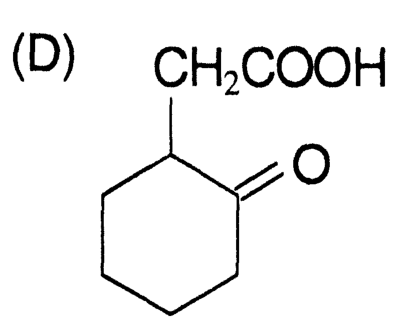
- Option (D) is a -keto acid, where the carbonyl group is at the -position relative to the carboxylic acid group.
Decarboxylation Mechanism of -Keto Acids:
-keto acids undergo decarboxylation under very mild conditions (gentle heating or room temperature) through a concerted cyclic six-membered transition state:
- Intramolecular Hydrogen Bonding: The carboxylic acid proton forms a stable six-membered ring via intramolecular hydrogen bonding with the carbonyl oxygen atom at the -position.
- Concerted Electron Shift:
- Tautomerization: The enol intermediate rapidly tautomerizes to give the corresponding ketone (cyclohexanone).
Because the ketone carbonyl () is a significantly stronger electron-withdrawing group than the carboxylic acid group in -dicarboxylic acids, the cyclic six-membered transition state is formed most readily in the -keto acid (Option B), resulting in the lowest activation energy for decarboxylation.
Thus, Option B undergoes decarboxylation most readily under mild conditions.