Distance Between Mirrors for Image Formation at Source
Two identical concave mirrors each of focal length are facing each other as shown in the schematic diagram. The focal length is much larger than the size of the mirrors. A glass slab of thickness and refractive index is kept equidistant from the mirrors and perpendicular to their common principal axis. A monochromatic point light source is embedded at the center of the slab on the principal axis, as shown in the schematic diagram. For the image to be formed on itself, which of the following distances between the two mirrors is/are correct:
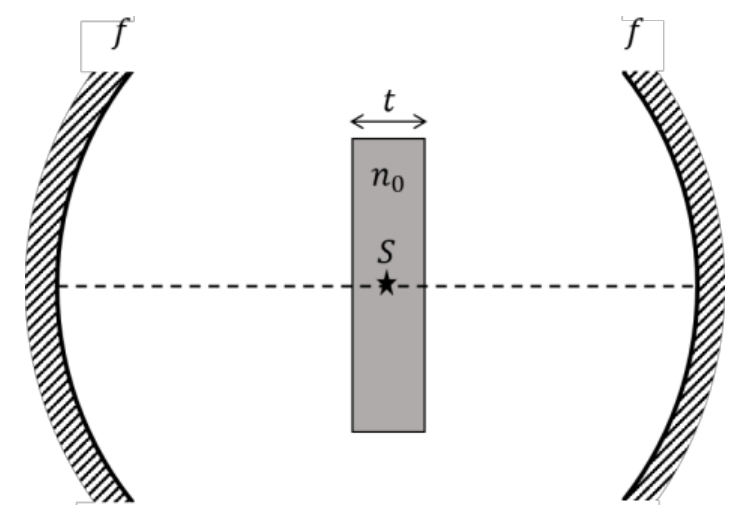
Options
Step-by-Step Solution
To determine the distance between the two concave mirrors such that the final image is formed on the source itself, we analyze the path of light rays from through refraction at the slab's surface and reflection from the mirrors.
1. Apparent Position of the Source
The monochromatic point light source is embedded at the center of the glass slab of refractive index and thickness . Therefore, is at a real distance of from either face of the slab.
When light rays travel from inside the glass medium () into air (), refraction occurs at the plane interface. Using the plane refraction formula:
Taking the real depth as :
Thus, to an observer in air (or looking from the concave mirror), the source appears to be at a virtual position located at a distance of behind the slab face.
2. Distance of Virtual Source from the Mirror
Let be the total distance between the two concave mirrors. Since the slab is placed symmetrically between them, the distance from either mirror to the nearest surface of the slab is:
The distance of the virtual source from either mirror is:
3. Conditions for Image Formation at
Case I: Rays retrace their path (Reflection at Center of Curvature)
If the virtual source is located at the center of curvature of the concave mirror, light rays strike the mirror normally and reflect back along their original paths, re-focusing at .
Setting :
This corresponds to Option (A).
Case II: Rays become parallel after reflection (Reflection at Focus)
If the virtual source is located at the principal focus of one mirror, the reflected light rays emerge parallel to the common principal axis.
Setting :
These parallel rays then travel towards the second mirror. Upon reflection from the second mirror, the rays converge towards its focal point. After re-entering the glass slab, refraction causes these converging rays to focus precisely at the point source .
This corresponds to Option (B).
Conclusion
The correct options are A and B.