Deviation Angle Sensitivity in Split Refractive Index Prism
Consider a prism with apex angle . The refractive indices of its left and right halves are given by and (), respectively, as shown in the diagram. The angle of incidence is chosen such that incident light rays experience minimum deviation when . For the case of unequal refractive indices where and (with ), the angle of emergence becomes . Which of the following statements is/are correct?
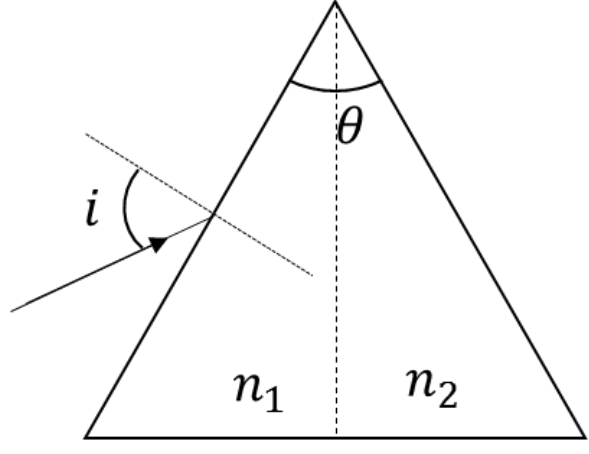
Options
The value of (in radians) is greater than that of
is proportional to
lies between and milliradians, if
lies between and milliradians, if
Topics & Concepts
Step-by-Step Solution
To determine which of the statements are correct, we analyze the refraction of light through the two-part prism step-by-step.
Step 1: Minimum Deviation Condition in the Symmetric Prism
For a uniform prism of apex angle and refractive index undergoing minimum deviation:
- The angle of refraction at the first surface is:
- Using Snell's law at the first surface:
- The cosine of the angle of incidence is:
Under the condition of minimum deviation, the ray inside the prism travels perpendicular to the angle bisector (the vertical interface separating the two media).
Step 2: Refraction across the Interface and Second Surface
The interface between the two halves of the prism lies along the bisector of the apex angle . Since the light ray inside the first half is perpendicular to this interface:
- The angle of incidence at the internal boundary is (normal incidence).
- The ray passes straight into the second medium without any deviation at the internal boundary.
- Therefore, inside the right half of the prism, the ray continues along the same direction and strikes the second surface at an angle of incidence:
For the second half with refractive index , Snell's law at the emergent surface gives:
Step 3: Relation between and
Expanding the right-hand side using small angle approximation for ():
Since , the equation simplifies to:
Using the numerical value of :
Step 4: Verification of the Options
-
Option A: . Thus, is less than , making Statement A incorrect.
-
Option B: Since , is directly proportional to . Thus, Statement B is correct.
-
Options C and D: For :
Since lies between and :
- Statement C is correct.
- Statement D is incorrect.
Conclusion
The correct options are B and C.