Determine Total Number of Aromatic Compounds and Species
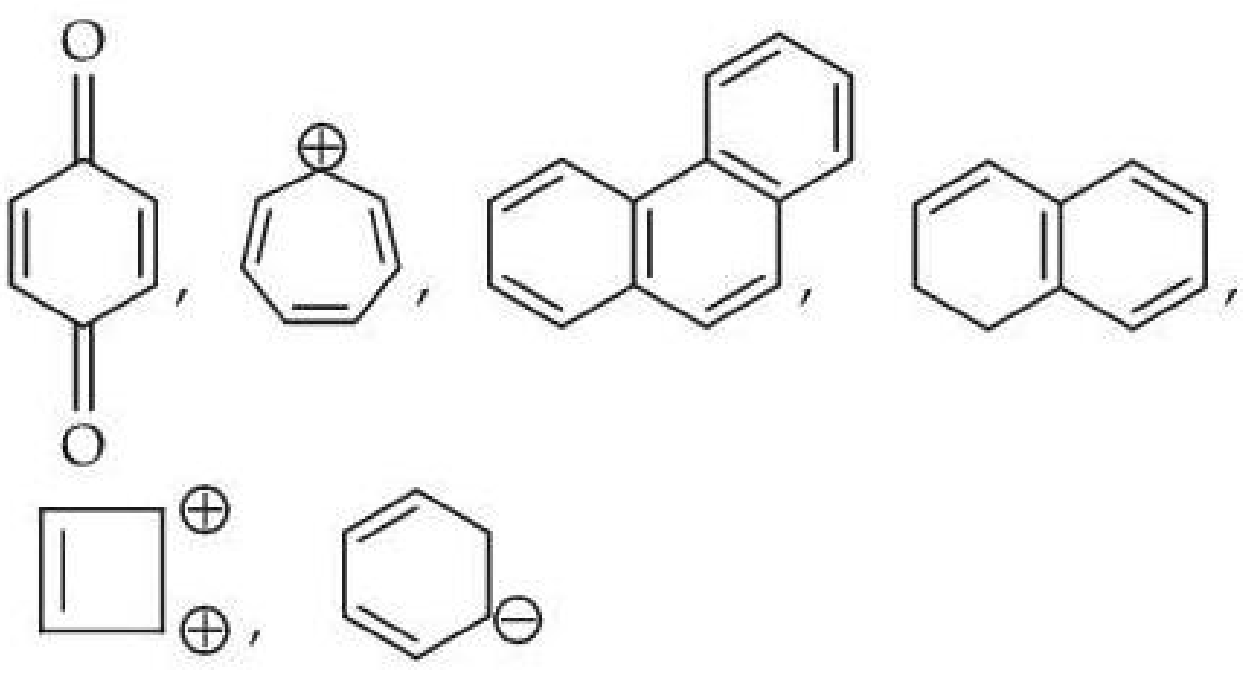
The total number of aromatic compounds/species from the following is
Options
A
6
B
4
CCorrect
3
D
5
Topics & Concepts
Step-by-Step Solution
To determine the total number of aromatic compounds/species from the given structures, we apply Hückel's Rule of Aromaticity.
A compound or species is defined as aromatic if it satisfies the following criteria:
- It is cyclic and planar.
- It exhibits complete cyclic conjugation (every atom in the ring system possesses an unhybridized -orbital, i.e., all ring vertices are hybridized).
- It contains -electrons in the conjugated system, where
Step-by-Step Analysis of Each Structure:
-
Structure 1 (-Benzoquinone / Cyclohexa-2,5-diene-1,4-dione):
- It contains a 6-membered ring with two carbonyl group double bonds and two ring double bonds.
- It lacks a continuous delocalized cyclic -electron system within the ring.
- Classification: Non-aromatic
-
Structure 2 (Tropylium Cation, ):
- Monocyclic, planar, 7-membered ring with 3 double bonds and one carbocation ( carbon with a vacant -orbital).
- All 7 carbons are hybridized, providing complete cyclic conjugation.
- Number of -electrons =
- Fits Hückel's rule: .
- Classification: Aromatic
-
Structure 3 (Phenanthrene):
- Fused polycyclic aromatic hydrocarbon composed of three benzene rings.
- Entirely planar and completely conjugated across the perimeter.
- Number of -electrons =
- Fits Hückel's rule: .
- Classification: Aromatic
-
Structure 4 (Tetralin / 1,2,3,4-Tetrahydronaphthalene):
- Consists of a benzene ring fused to a saturated 6-membered cyclohexane ring.
- Due to the presence of hybridized carbon atoms in the saturated ring, the complete bicyclic ring system is not fully conjugated throughout the entire molecule.
- Classification: Non-aromatic (as a unified bicyclic conjugated system)
-
Structure 5 (Cyclobutene Dication, ):
- A 4-membered ring with one double bond and two positive charges ( hybridized carbocations).
- All 4 ring carbons are hybridized, resulting in complete cyclic conjugation.
- Number of -electrons =
- Fits Hückel's rule: .
- Classification: Aromatic
-
Structure 6 (Cyclopentenyl Anion):
- A 5-membered ring containing one double bond and a carbanion, but also contains saturated carbon atoms.
- The continuous cyclic conjugation is interrupted by the carbons.
- Classification: Non-aromatic
Conclusion:
The aromatic species among the given structures are:
- Tropylium cation
- Phenanthrene
- Cyclobutene dication
The total number of aromatic compounds/species is 3.
Correct Option: C