Determine Pressure Increase Required for Test Tube Sinking
A soft plastic bottle containing water of density contains an inverted glass test-tube with trapped air (ideal gas) as depicted in the figure. The test-tube mass is and it is made of thick glass with a density of . Initially, the bottle is sealed under atmospheric pressure , with the trapped air occupying a volume of . When squeezed from the outside under isothermal conditions, the internal pressure increases while the volume of trapped air decreases. It is observed that the test tube starts sinking at a pressure of maintaining its vertical orientation. Under this pressure, the volume of trapped air becomes . Let and .
Calculate the value of .
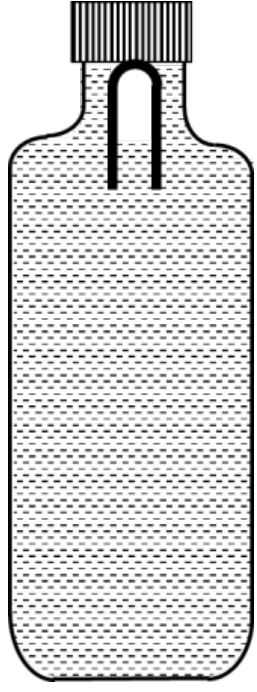
Topics & Concepts
Step-by-Step Solution
To determine the value of , we analyze the force equilibrium of the test-tube at the moment it begins to sink.
Step 1: Calculate the Volume of the Glass
Given:
- Mass of the test-tube,
- Density of the glass,
The volume occupied by the glass material itself is:
Step 2: Condition for Sinking
The test-tube starts to sink when its average density becomes equal to the density of water (), i.e., when the total weight of the test-tube equals the buoyant force exerted by the displaced water.
Let be the volume of the trapped air when the test-tube begins to sink. The total volume of water displaced by the test-tube and trapped air is:
For neutral buoyancy:
Step 3: Apply Isothermal Compression (Boyle's Law)
The trapped air undergoes an isothermal process as the internal pressure increases from to .
Given:
- Initial atmospheric pressure,
- Initial air volume,
- Final air volume,
Using Boyle's law ():
Substitute the given values into the equation:
Step 4: Determine
We are given that . Expressing in terms of :
Thus,