Determine Monocyclic Product With Highest Unsaturated Carbon Atoms
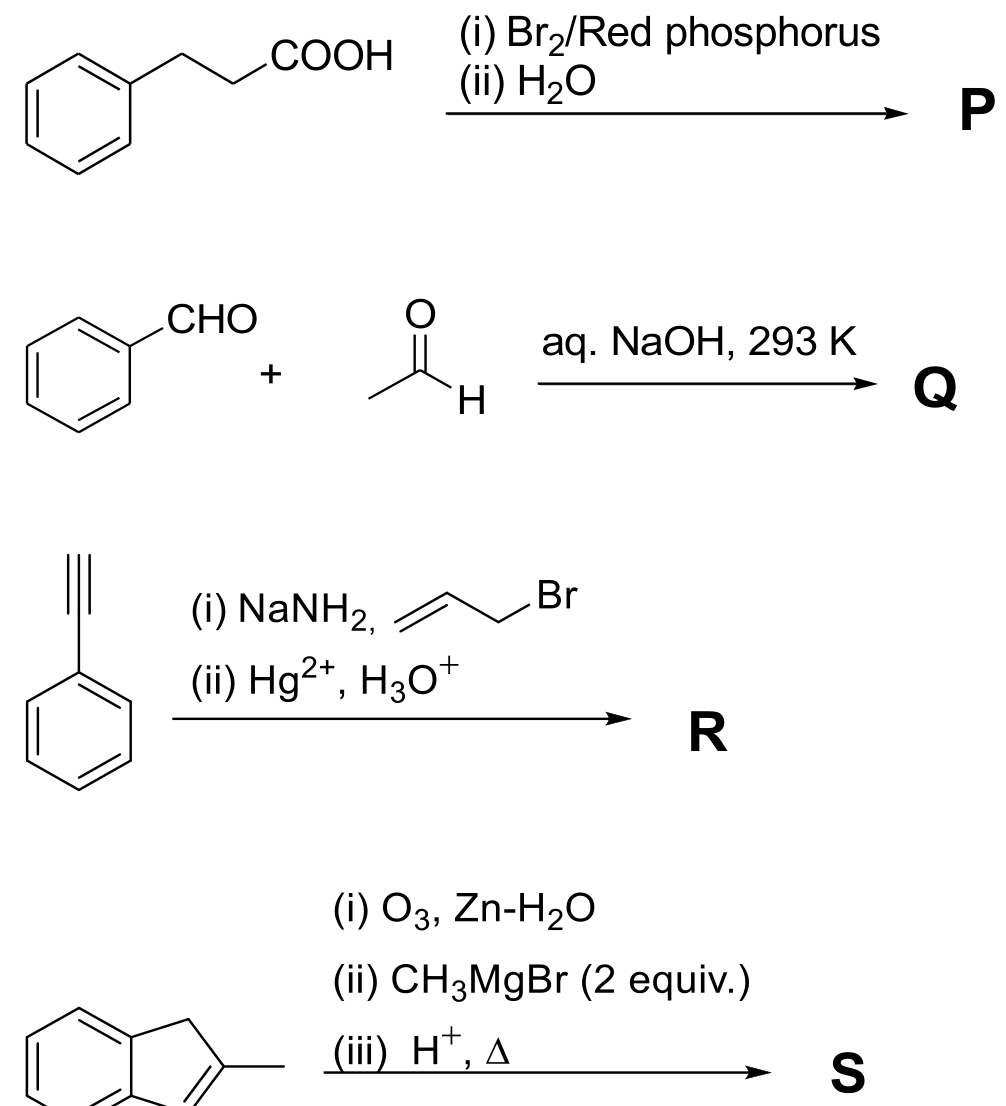
Monocyclic compounds P, Q, R and S are the major products formed in the reaction sequences given below.
The product having the highest number of unsaturated carbon atom(s) is
Options
A
P
B
Q
C
R
DCorrect
S
Step-by-Step Solution
To determine which product has the highest number of unsaturated carbon atoms, we analyze the reaction sequence for each monocyclic product (P, Q, R, and S). An unsaturated carbon atom is defined as a carbon atom involved in a double or triple bond ( or hybridized).
1. Formation and Structure of Product P
- Reactant: 3-phenylpropanoic acid ()
- Reaction:
- followed by is the Hell-Volhard-Zelinsky (HVZ) reaction, which selectively brominates the -position of carboxylic acids.
- Product P: 2-bromo-3-phenylpropanoic acid ()
- Unsaturated Carbon Count:
- Benzene ring: aromatic carbon atoms
- Carboxylic acid group (): carbonyl carbon atom
- Total unsaturated carbon atoms in P
2. Formation and Structure of Product Q
- Reactants: Benzaldehyde () and acetaldehyde ()
- Reaction:
- Cross-aldol condensation (Claisen-Schmidt condensation) in the presence of base () followed by dehydration.
- Product Q: Trans-cinnamaldehyde ()
- Unsaturated Carbon Count:
- Benzene ring: aromatic carbon atoms
- Alkenic double bond (): carbon atoms
- Aldehyde group (): carbonyl carbon atom
- Total unsaturated carbon atoms in Q
3. Formation and Structure of Product R
- Reactant: Ethynylbenzene ()
- Reaction:
- Treatment with deprotonates the terminal alkyne to form an acetylide ion, which reacts with allyl bromide () via an nucleophilic substitution to give .
- Oxymercuration-hydration () selectively hydrates the alkyne according to Markovnikov's rule to yield a ketone.
- Product R: 1-phenylpent-4-en-1-one ()
- Unsaturated Carbon Count:
- Benzene ring: aromatic carbon atoms
- Carbonyl group (): carbonyl carbon atom
- Terminal alkene group (): carbon atoms
- Total unsaturated carbon atoms in R
4. Formation and Structure of Product S
- Reactant: A bicyclic indene derivative, 3-ethyl-1H-indene (containing a benzene ring fused to a 5-membered cyclopentene ring).
- Reaction:
- Reductive ozonolysis () cleaves the endocyclic double bond of the cyclopentene ring, opening the 5-membered ring to yield a monocyclic dicarbonyl intermediate.
- Reaction with 2 equivalents of methylmagnesium bromide () adds a methyl group to each of the two carbonyl carbon atoms, forming alcohol functions.
- Acid-catalyzed dehydration () eliminates two molecules of water to yield two new alkenic double bonds.
- Product S: A monocyclic compound containing a benzene ring and two double bonds in the side chains.
- Unsaturated Carbon Count:
- Benzene ring: aromatic carbon atoms
- Two alkenic double bonds (): carbon atoms
- Total unsaturated carbon atoms in S
Comparison:
- P:
- Q:
- R:
- S:
Product S has the highest number of unsaturated carbon atoms ().
Correct Option: D