Hydroboration-oxidation follows anti-Markovnikov addition of water across the carbon-carbon double bond.
Thus, compound P is 2-phenylethan-1-ol (Ph−CH2−CH2OH).
2. Formation of Compound Q:
Starting from compound P (Ph−CH2−CH2OH):
Oxidation with Jones Reagent (CrO3,H2SO4):
Primary alcohol is oxidized to 2-phenylacetic acid:
Ph−CH2−CH2OHCrO3,H2SO4Ph−CH2−COOH
Hell-Volhard-Zelinsky (HVZ) Reaction (Cl2,Red P followed by H2O):
Halogenation occurs selectively at the α-position of the carboxylic acid:
Ph−CH2−COOH(ii) Cl2,Red P,(iii) H2OPh−CH(Cl)−COOH
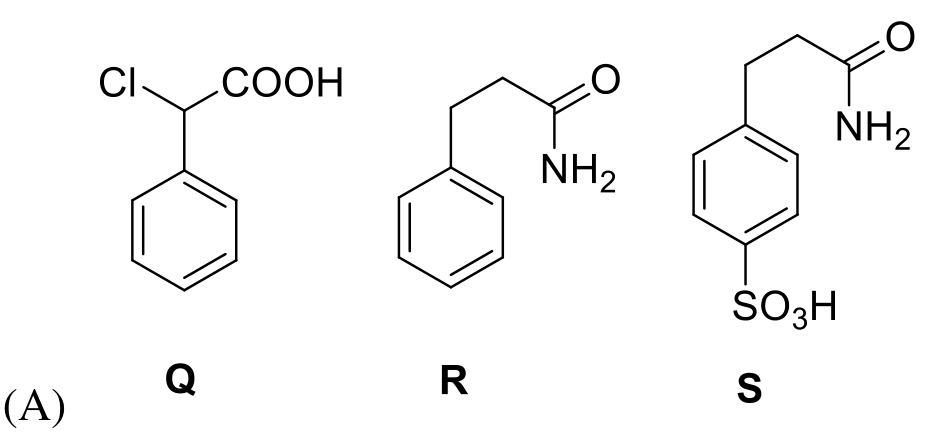
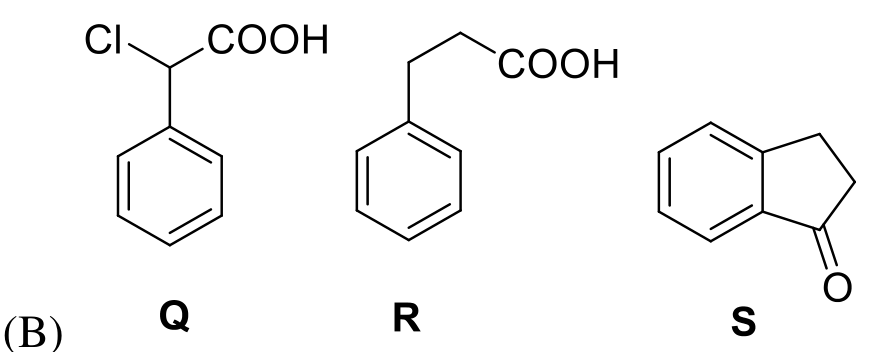
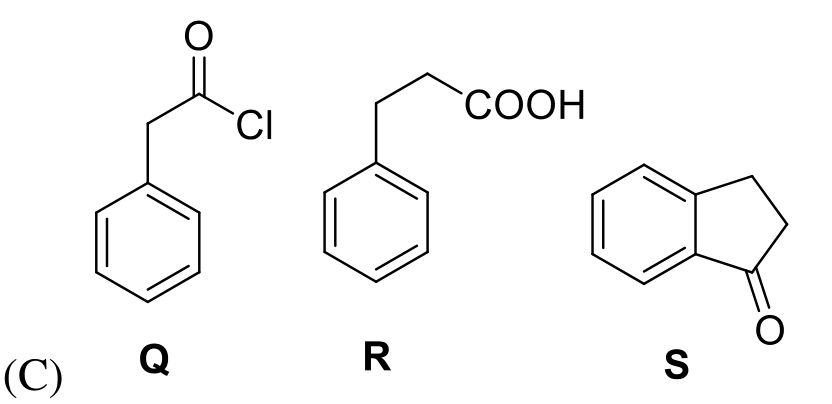
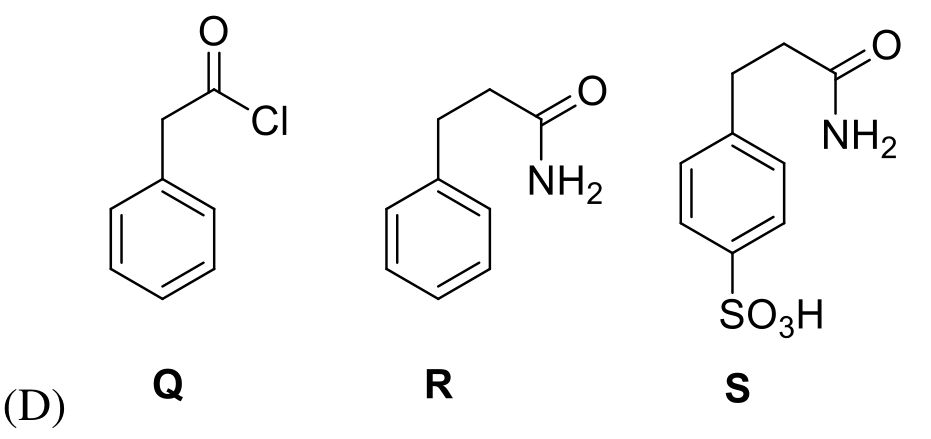
Thus, compound Q is 2-chloro-2-phenylacetic acid (Ph−CH(Cl)−COOH).
3. Formation of Compound R:
Starting from compound P (Ph−CH2−CH2OH):
Chlorination with SOCl2:Ph−CH2−CH2OHSOCl2Ph−CH2−CH2Cl
Nucleophilic Substitution with NaCN:Ph−CH2−CH2ClNaCNPh−CH2−CH2CN
Acid Hydrolysis (H3O+,Δ):
Complete hydrolysis of the nitrile yields 3-phenylpropanoic acid:
Ph−CH2−CH2CNH3O+,ΔPh−CH2−CH2−COOH
Thus, compound R is 3-phenylpropanoic acid (Ph−CH2−CH2−COOH).
4. Formation of Compound S:
3-phenylpropanoic acid (R) in the presence of concentrated H2SO4 undergoes an intramolecular Friedel-Crafts acylation:
Ph−CH2−CH2−COOHconc. H2SO41-indanone
The carboxyl hydroxyl group gets protonated and loses water to form an acylium ion (−C+=O).
Electrophilic aromatic substitution occurs intramolecularly at the ortho-position of the benzene ring, forming the five-membered fused cyclic ketone, 1-indanone.
Conclusion:
Matching the derived structures for Q, R, and S with the given choices: