Determine Capacitance Difference Between Metal Plates Over Time
Comprehension Passage
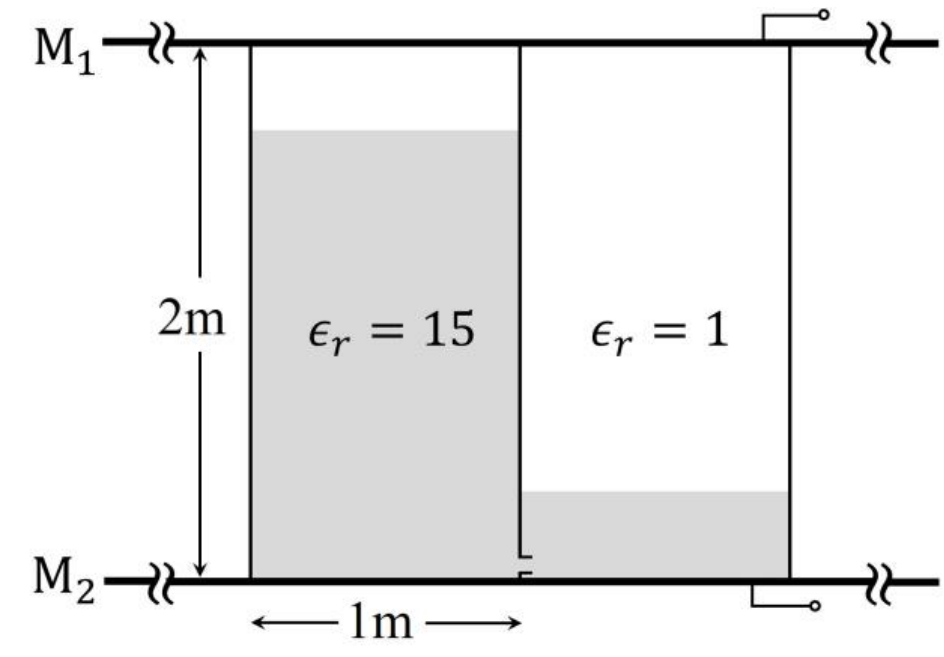
A container of height 2 m, length 2 m and breadth 1 m is made of insulating vertical walls and two large area horizontal metal plates (M1 and M2) which extend far beyond the vertical walls in all directions. The container is partitioned into two equal chambers with a thin insulating vertical wall. The partition wall contains a small hole of cross-sectional area 10 cm2 near its bottom edge. Initially the hole is closed and the left chamber of the container is completely filled with a liquid of dielectric constant ϵr=15 and the right chamber is empty (ϵr=1). At time t=0, the hole is opened and the liquid flows from the left chamber to the right chamber. In both the chambers, the space above the liquid has ϵr=1 and is maintained at atmospheric pressure. The schematic of the container at a time t>0 is shown in the figure.
[Given: acceleration due to gravity is 10 ms−2.]
The difference in the capacitance (in F) between the metal plates at t=0 and that at t=500 s is (8−n)ϵ0, where ϵ0 is the permittivity of free space. The value of n is:
To determine the value of n, we break the problem into two parts: determining the heights of the liquid in the two chambers at t=500 s, and evaluating the total capacitance of the system at t=0 and t=500 s.
Step 1: Determining the liquid heights at t=500 s
The container has dimensions 2 m×2 m×1 m (height × total length × breadth). Since it is partitioned into two equal chambers:
Area of cross-section of each chamber, A=1 m×1 m=1 m2.
Total height of container, H=2 m.
Hole area, a=10 cm2=10×10−4 m2.
Let h1 and h2 be the heights of the liquid in the left and right chambers at time t, respectively. By conservation of volume:
Ah1+Ah2=AH⟹h1+h2=2⟹h2=2−h1
The pressure difference at the hole near the bottom is ΔP=ρg(h1−h2). Using Torricelli's Law, the speed of efflux is:
v=2g(h1−h2)
The rate of decrease of height h1 is given by:
−Adtdh1=av=a2g(h1−h2)
Substituting the given numerical values (g=10 ms−2, a=10×10−4 m2, A=1 m2):
−dtdh1=2(10×10−4)10(h1−1)=2×10⁻³h1−1
Separating the variables and integrating from t=0 to t=500 s:
∫2h1h1−1−dh1=2×10⁻³∫0500dt[−2h1−1]2h1=2×10−3×500=1−2h1−1+22−1=12−2h1−1=1⟹h1−1=0.5⟹h1−1=0.25
Thus, at t=500 s:
h1=1.25 m=45 mh2=2−1.25=0.75 m=43 m
Step 2: Capacitance Calculation
Each chamber acts as two capacitors in series: a liquid column of height h with dielectric constant ϵr=15 and an air column of height (2−h) with dielectric constant ϵr=1.
For a chamber with liquid height h:
Capacitance of the liquid dielectric part:
Cliq=hϵrϵ0A=h15ϵ0
Capacitance of the air part:
Cair=2−hϵ0A=2−hϵ0
Since these two regions are stacked vertically between the plates, their equivalent capacitance Cchamber is:
Cchamber1=Cliq1+Cair1=15ϵ0h+ϵ02−h=ϵ01(2−1514h)Cchamber(h)=2−1514hϵ0
The left and right chambers are in parallel across plates M1 and M2, so the total capacitance is:
Ctotal=CL(h1)+CR(h2)
At t=0:
Here h1=2 m and h2=0 m:
CL(2)=2−1528ϵ0=215ϵ0=7.5ϵ0CR(0)=2−0ϵ0=0.5ϵ0C(0)=7.5ϵ0+0.5ϵ0=8ϵ0
At t=500 s:
Here h1=45 m and h2=43 m:
CL(45)=2−1514×45ϵ0=2−67ϵ0=56ϵ0=1.2ϵ0CR(43)=2−1514×43ϵ0=2−107ϵ0=1310ϵ0
The total capacitance at t=500 s is:
C(500)=(56+1310)ϵ0=65128ϵ0
Step 3: Finding n
The difference in capacitance between t=0 and t=500 s is:
ΔC=C(0)−C(500)=8ϵ0−65128ϵ0=(8−65128)ϵ0
Comparing this with the given expression (8−n)ϵ0:
n=65128≈1.97
Determine Capacitance Difference Between Metal Plates Over Time | Physics PYQ Solution - JEE Challenger