Descending Order of Acidity Among Substituted Phenols and Carboxylic Acids
The descending order of acidity among the following compounds is:
Choose the correct answer from the options given below:
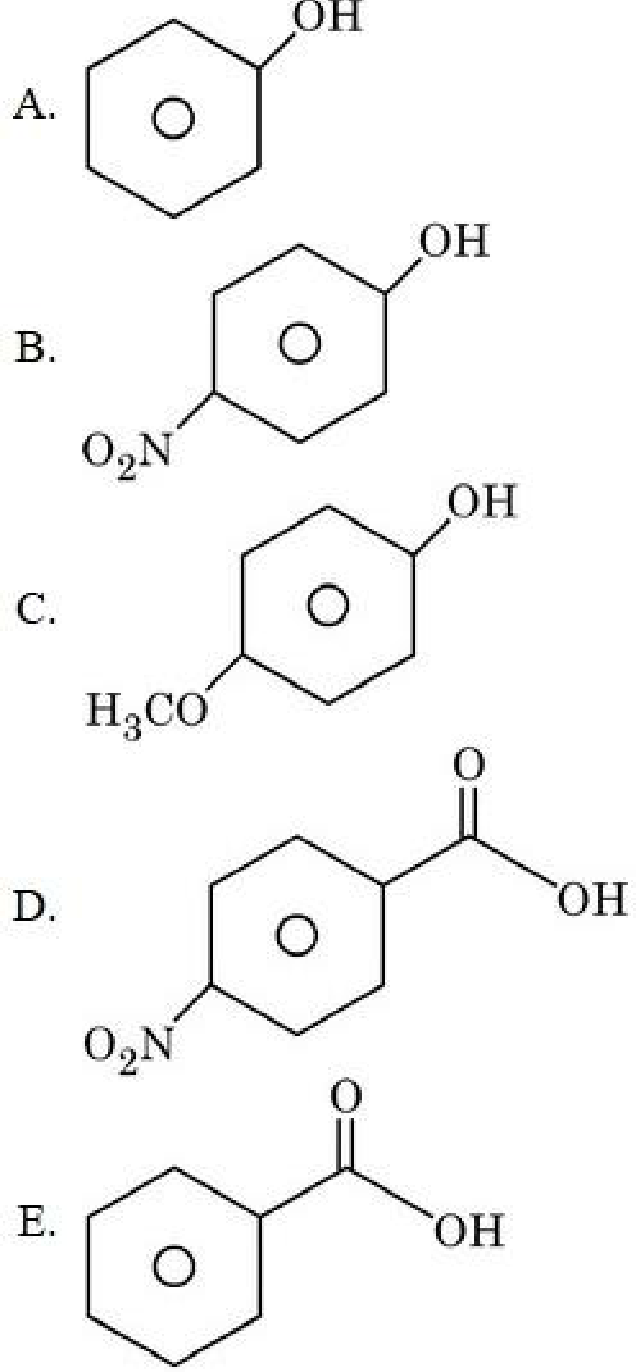
Options
A
B
C
D
Correct
Step-by-Step Solution
To determine the descending order of acidity among the given compounds, we analyze the stability of their respective conjugate bases formed after the loss of a proton ().
1. Comparison Between Carboxylic Acids and Phenols
- Carboxylic Acids (D and E): Carboxylic acids are substantially stronger acids than phenols. The conjugate base of a carboxylic acid (a carboxylate ion, ) is stabilized by resonance between two equivalent canonical structures where the negative charge is delocalized over two highly electronegative oxygen atoms.
- Phenols (A, B, and C): In a phenoxide ion (), the negative charge is delocalized onto the carbon atoms of the aromatic ring, which are less electronegative than oxygen atoms. Thus, phenoxide ions are less stable than carboxylate ions.
Therefore, carboxylic acids (D and E) are more acidic than phenols (A, B, and C).
2. Comparing Carboxylic Acids: D vs. E
- D (4-Nitrobenzoic acid): The nitro () group at the para-position is a strong electron-withdrawing group through both inductive () and resonance/mesomeric () effects. This drastically stabilizes the carboxylate anion, making 4-nitrobenzoic acid the strongest acid among the given options ().
- E (Benzoic acid): Unsubstituted benzoic acid lacks the electron-withdrawing nitro group ().
3. Comparing Phenols: B, A, and C
- B (4-Nitrophenol): The group at the para-position exerts strong and effects, heavily stabilizing the phenoxide ion and drastically increasing its acidity ().
- A (Phenol): Unsubstituted phenol ().
- C (4-Methoxyphenol): The methoxy () group at the para-position exerts a strong electron-donating resonance () effect, which destabilizes the phenoxide ion, thereby decreasing its acidity relative to phenol ().
Conclusion
Combining the individual orders:
This matches Option D.