From the radioactive decay law, the number of nuclei N ( t ) N(t) N ( t ) t t t N ( t ) = N 0 e − λ t N(t) = N_0 e^{-\lambda t} N ( t ) = N 0 e − λ t
The magnitude of the rate of decay (activity) at time t t t ∣ d N ( t ) d t ∣ = λ N ( t ) = λ N 0 e − λ t \left|\frac{\mathrm{d}N(t)}{\mathrm{d}t}\right| = \lambda N(t) = \lambda N_0 e^{-\lambda t} d t d N ( t ) = λ N ( t ) = λ N 0 e − λ t
Taking the natural logarithm of both sides:ln ∣ d N ( t ) d t ∣ = ln ( λ N 0 ) − λ t \ln\left|\frac{\mathrm{d}N(t)}{\mathrm{d}t}\right| = \ln(\lambda N_0) - \lambda t ln d t d N ( t ) = ln ( λ N 0 ) − λ t
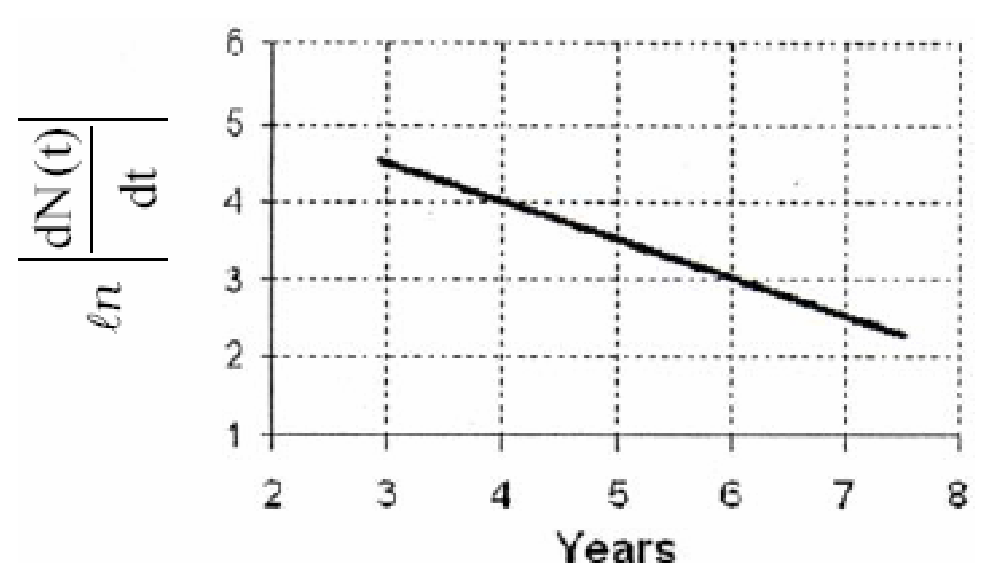
This represents a linear relation between ln ∣ d N ( t ) d t ∣ \ln\left|\frac{\mathrm{d}N(t)}{\mathrm{d}t}\right| ln d t d N ( t ) t t t λ \lambda λ Slope = − λ \text{Slope} = -\lambda Slope = − λ
From the given graph, we identify points on the line:
At t = 3 years t = 3\text{ years} t = 3 years ln ∣ d N ( t ) d t ∣ ≈ 4.5 \ln\left|\frac{\mathrm{d}N(t)}{\mathrm{d}t}\right| \approx 4.5 ln d t d N ( t ) ≈ 4.5
At t = 7 years t = 7\text{ years} t = 7 years ln ∣ d N ( t ) d t ∣ ≈ 2.5 \ln\left|\frac{\mathrm{d}N(t)}{\mathrm{d}t}\right| \approx 2.5 ln d t d N ( t ) ≈ 2.5
Thus, the decay constant is:λ = − 2.5 − 4.5 7 − 3 = 2 4 = 0.5 year − 1 \lambda = -\frac{2.5 - 4.5}{7 - 3} = \frac{2}{4} = 0.5\text{ year}^{-1} λ = − 7 − 3 2.5 − 4.5 = 4 2 = 0.5 year − 1
The half-life T 1 / 2 T_{1/2} T 1/2 T 1 / 2 = ln 2 λ = 0.693 0.5 ≈ 1.386 years T_{1/2} = \frac{\ln 2}{\lambda} = \frac{0.693}{0.5} \approx 1.386\text{ years} T 1/2 = λ l n 2 = 0.5 0.693 ≈ 1.386 years
We are given that after t = 4.16 years t = 4.16\text{ years} t = 4.16 years p p p N 0 N ( t ) = e λ t = p \frac{N_0}{N(t)} = e^{\lambda t} = p N ( t ) N 0 = e λ t = p
Taking natural logarithm on both sides:ln p = λ t = 0.5 × 4.16 = 2.08 \ln p = \lambda t = 0.5 \times 4.16 = 2.08 ln p = λ t = 0.5 × 4.16 = 2.08
Since ln 2 ≈ 0.693 \ln 2 \approx 0.693 ln 2 ≈ 0.693 2.08 ≈ 3 × 0.693 = 3 ln 2 = ln ( 2 3 ) = ln 8 2.08 \approx 3 \times 0.693 = 3 \ln 2 = \ln(2^3) = \ln 8 2.08 ≈ 3 × 0.693 = 3 ln 2 = ln ( 2 3 ) = ln 8
Therefore,p = 8 p = 8 p = 8