JEE Challenger
More from Current Electricity

Current Through Resistor in Galvanometer Half Deflection Method

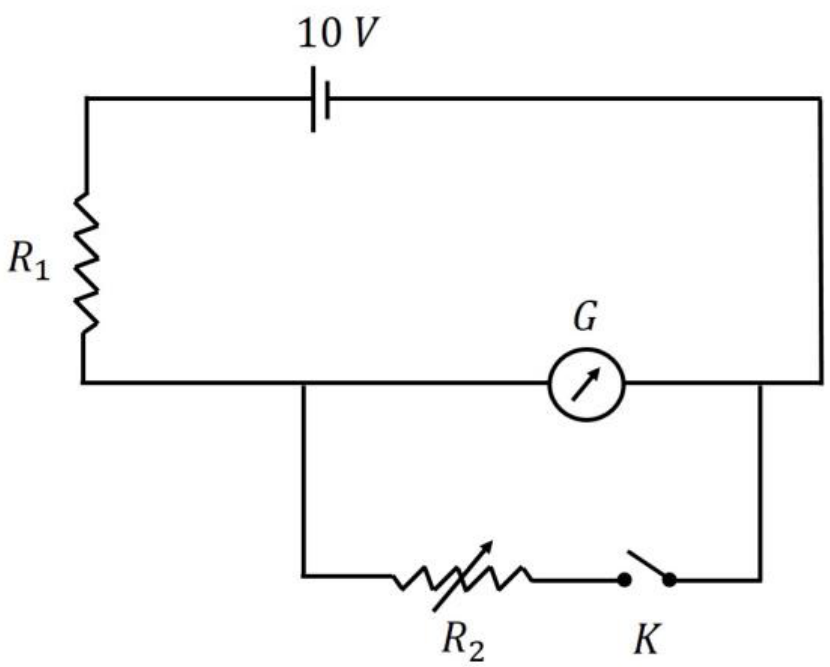
As shown in the figure, the resistance of a galvanometer GG can be found by the half-deflection method. Here the resistance R2R_2 is adjusted such that when the key KK is closed the deflection in the galvanometer becomes half of the value as compared to when KK is open. Half-deflection is obtained at R2=4 ΩR_2 = 4\ \Omega and thus the galvanometer resistance is found to be 6 Ω6\ \Omega. In this half-deflection condition the current (in mA) through the resistor R1R_1 is:

Question Diagram 1
Official Numerical Answer690 to 710

Step-by-Step Solution

To find the current through the resistor R1R_1 in the half-deflection condition, we analyze the circuit in both states (when key KK is open and when key KK is closed).

1. Circuit Parameters from Diagram and Given Text

  • Voltage of the source, V=10 VV = 10\text{ V}
  • Resistance of the galvanometer, G=6 ΩG = 6\ \Omega
  • Shunt resistance for half-deflection, R2=4 ΩR_2 = 4\ \Omega

2. Derivation of Resistance R1R_1

Case 1: Key KK is Open

When the key KK is open, no current flows through R2R_2. The total resistance of the circuit is R1+GR_1 + G. The current flowing through the galvanometer is given by: Ig=VR1+GI_g = \frac{V}{R_1 + G}

Case 2: Key KK is Closed (Half-deflection Condition)

When key KK is closed, resistor R2R_2 is connected in parallel with the galvanometer GG. The equivalent resistance of this parallel combination RpR_p is: Rp=GR2G+R2R_p = \frac{G R_2}{G + R_2}

The total resistance of the circuit is Rtotal=R1+RpR_{\text{total}} = R_1 + R_p. The total current supplied by the battery (which is the current flowing through R1R_1) is: I=VR1+Rp=VR1+GR2G+R2I = \frac{V}{R_1 + R_p} = \frac{V}{R_1 + \frac{G R_2}{G + R_2}}

Using the current divider rule, the current through the galvanometer in this case, IgI_g', is: Ig=I×R2G+R2=VR1+GR2G+R2×R2G+R2=VR2R1(G+R2)+GR2I_g' = I \times \frac{R_2}{G + R_2} = \frac{V}{R_1 + \frac{G R_2}{G + R_2}} \times \frac{R_2}{G + R_2} = \frac{V R_2}{R_1 (G + R_2) + G R_2}

According to the half-deflection condition, Ig=12IgI_g' = \frac{1}{2} I_g: VR2R1(G+R2)+GR2=12(VR1+G)\frac{V R_2}{R_1 (G + R_2) + G R_2} = \frac{1}{2} \left( \frac{V}{R_1 + G} \right)

Simplifying the equation: R2R1G+R1R2+GR2=12(R1+G)\frac{R_2}{R_1 G + R_1 R_2 + G R_2} = \frac{1}{2(R_1 + G)} 2R2(R1+G)=R1G+R1R2+GR22 R_2 (R_1 + G) = R_1 G + R_1 R_2 + G R_2 2R1R2+2GR2=R1G+R1R2+GR22 R_1 R_2 + 2 G R_2 = R_1 G + R_1 R_2 + G R_2 R1R2+GR2=R1GR_1 R_2 + G R_2 = R_1 G R1(GR2)=GR2    R1=GR2GR2R_1 (G - R_2) = G R_2 \implies R_1 = \frac{G R_2}{G - R_2}


3. Calculation of R1R_1 and Total Current II

Substitute G=6 ΩG = 6\ \Omega and R2=4 ΩR_2 = 4\ \Omega into the formula for R1R_1: R1=6×464=242=12 ΩR_1 = \frac{6 \times 4}{6 - 4} = \frac{24}{2} = 12\ \Omega

Now, calculate the equivalent parallel resistance RpR_p: Rp=6×46+4=2410=2.4 ΩR_p = \frac{6 \times 4}{6 + 4} = \frac{24}{10} = 2.4\ \Omega

The total resistance of the circuit in the half-deflection condition is: Rtotal=R1+Rp=12+2.4=14.4 ΩR_{\text{total}} = R_1 + R_p = 12 + 2.4 = 14.4\ \Omega

The current through R1R_1 in amperes is: I=VRtotal=1014.4=100144=2536 AI = \frac{V}{R_{\text{total}}} = \frac{10}{14.4} = \frac{100}{144} = \frac{25}{36}\text{ A}

Converting the current to milliamperes (mA\text{mA}): I=2536×1000 mA=2500036 mA=62509 mA694.44 mAI = \frac{25}{36} \times 1000\text{ mA} = \frac{25000}{36}\text{ mA} = \frac{6250}{9}\text{ mA} \approx 694.44\text{ mA}


Final Answer

The current through the resistor R1R_1 in the half-deflection condition is 694.44 mA694.44\text{ mA} (or 62509 mA\frac{6250}{9}\text{ mA}).

Current Through Resistor in Galvanometer Half Deflection Method | Physics PYQ Solution - JEE Challenger