Count Compounds Yielding Amine via Hofmann Degradation and Gabriel Phthalimide Synthesis
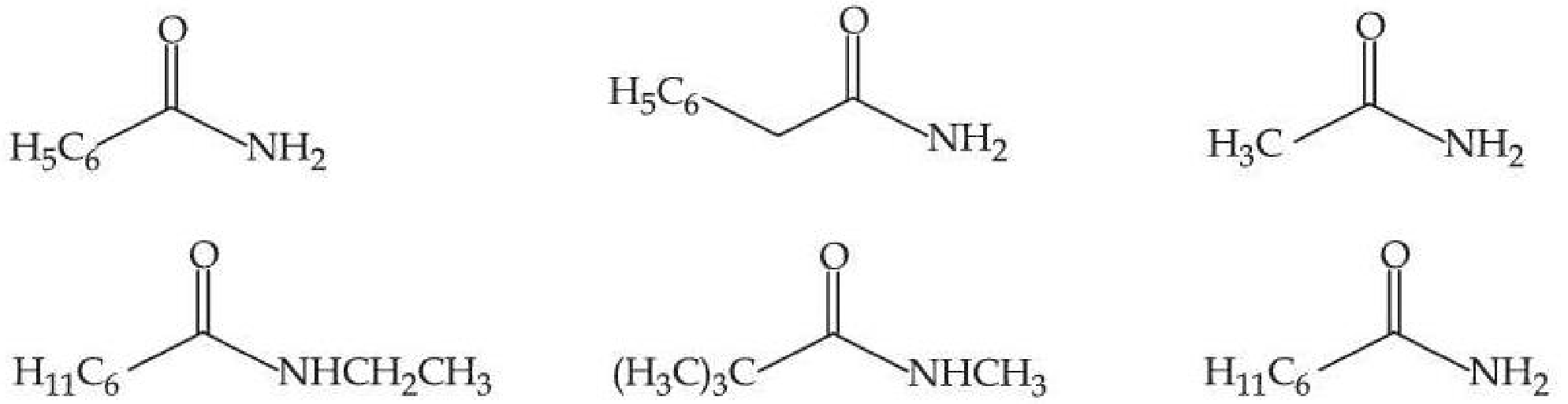
Step-by-Step Solution
To determine the number of compounds that satisfy the given conditions, let us analyze the requirements for both chemical reactions:
-
Hofmann Bromamide Degradation Reaction ():
- The starting compound must be an unsubstituted primary amide ().
- Secondary () and tertiary () amides do not undergo Hofmann degradation to yield amines.
-
Gabriel Phthalimide Synthesis:
- This method is specifically used for the preparation of primary aliphatic amines ().
- Aromatic primary amines (e.g., Aniline) cannot be prepared by Gabriel phthalimide synthesis because aryl halides do not undergo nucleophilic substitution () with the phthalimide anion due to partial double bond character of the bond.
Step-by-Step Evaluation of the Given Compounds:
-
(Benzamide):
- Hofmann degradation: Yields Aniline ().
- Gabriel phthalimide synthesis: Not possible for Aniline, as chlorobenzene/bromobenzene cannot undergo reaction.
- ❌ Excluded
-
(2-Phenylacetamide):
- Hofmann degradation: Yields Benzylamine ().
- Gabriel phthalimide synthesis: Possible, as benzyl amine is a primary aliphatic amine that can be prepared using benzyl chloride ().
- ✅ Included
-
(Acetamide):
- Hofmann degradation: Yields Methylamine ().
- Gabriel phthalimide synthesis: Possible, as methylamine is a primary aliphatic amine prepared from methyl halide ().
- ✅ Included
-
(-Ethylcyclohexanecarboxamide):
- It is an -substituted (secondary) amide.
- Hofmann degradation: Does not undergo Hofmann degradation reaction.
- ❌ Excluded
-
(-Methylpivalamide):
- It is an -substituted (secondary) amide.
- Hofmann degradation: Does not undergo Hofmann degradation reaction.
- ❌ Excluded
-
(Cyclohexanecarboxamide):
- Hofmann degradation: Yields Cyclohexylamine ().
- Gabriel phthalimide synthesis: Possible, as cyclohexylamine is a primary aliphatic amine.
- ✅ Included
Conclusion:
The number of compounds satisfying both conditions is 3 (, , and ).
Correct Option: C