Compare SN2 Reaction Rates of Alkyl and Acyl Chlorides with Potassium Iodide
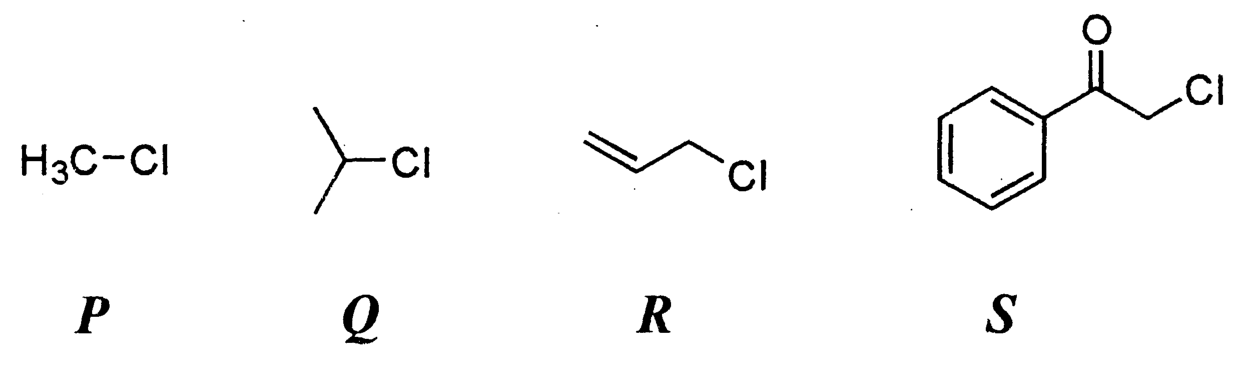
Potassium iodide () dissolved in acetone undergoes an substitution reaction with each of the following substrates , , , and . The relative rates of reaction follow the order:
Options
A
B
Correct
C
D
Step-by-Step Solution
To determine the relative rates of the reaction of the given substrates with potassium iodide () in acetone (the Finkelstein reaction), we examine the electronic and steric factors affecting the transition state of each substrate:
-
Substrate (, Phenacyl chloride):
- It is an -haloketone. The adjacent carbonyl group () exerts a strong electron-withdrawing inductive effect (), creating a significant partial positive charge () on the -carbon and making it exceptionally electrophilic.
- More importantly, in the transition state, the partially formed and broken bonds (represented by a developing -orbital on the reaction center) overlap effectively with the adjacent orbital of the carbonyl group. This conjugated interaction significantly stabilizes the transition state, leading to a drastically lowered activation energy ().
- As a result, -haloketones undergo substitution thousands of times faster than simple alkyl halides. Thus, substrate has the highest rate of reaction.
-
Substrate (, Methyl chloride):
- Methyl halides possess negligible steric hindrance around the carbon undergoing nucleophilic attack. Since the reaction is extremely sensitive to steric hindrance, the absence of alkyl substituents allows for a rapid backside attack by the iodide ion ().
-
Substrate (, Allyl chloride):
- Although the allylic system offers transition state stabilization through -orbital overlap, it is a primary halide with a vinyl substituent, which offers greater steric bulk than the hydrogens in methyl chloride ().
-
Substrate (, Isopropyl chloride):
- This is a secondary () alkyl halide with two bulky methyl groups attached to the reacting center. The increased steric hindrance substantially disfavors the backside attack required in an mechanism, resulting in the slowest reaction rate among the given substrates.
Comparing the relative rates across the options, only Option (B) correctly places the exceptionally reactive -haloketone () as the fastest substrate:
Therefore, the correct option is (B).