Collision of Projected Pebble with Oscillating Block on Spring
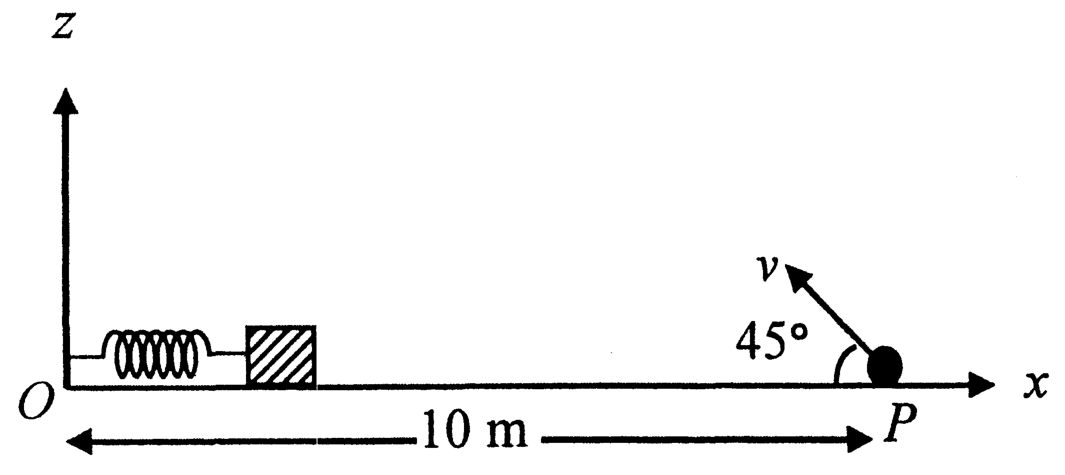
Consider a small block connected to one end of a massless spring having an un-stretched length of . The opposite end of the spring is held fixed at point (see figure). The assembly rests upon a frictionless horizontal surface. The block is pulled by and released from rest at time , executing simple harmonic motion with an angular frequency . At the same instant , a small pebble is launched with speed from a point at an elevation angle of as depicted. Point is located at a horizontal distance of from . If the pebble collides with the block at , determine the value of (taking ).
Options
Topics & Concepts
Step-by-Step Solution
To find the initial speed of the pebble, we analyze the motion of both the block executing simple harmonic motion (SHM) and the pebble executing projectile motion.
1. Motion of the Block
The fixed end of the spring is at the origin . The unstretched length of the spring is .
At , the block is stretched by from its mean position and released from rest. Therefore, the block undergoes Simple Harmonic Motion along the -axis about its mean position with amplitude and angular frequency .
The position of the block as a function of time is given by:
Substituting the given values:
At , the horizontal position of the block is:
2. Motion of the Pebble
The pebble is projected from point at an angle of with the horizontal towards the origin .
The components of initial velocity are:
- Horizontal velocity:
- Vertical velocity:
The coordinates of the pebble at time are:
3. Collision Condition
For the pebble to hit the block at , its vertical displacement must bring it to the horizontal ground (), and its horizontal position must match that of the block:
Vertical Condition:
Horizontal Condition Verification:
Substituting into the expression for :
Since , the pebble and the block are at the exact same location at .
Thus, the initial speed of projection is .
Correct Option: (A)