Collision of Ball with Rolling Ring on Horizontal Surface
A thin ring of mass and radius is rolling without slipping on a horizontal plane with velocity . A small ball of mass , moving with velocity in the opposite direction, hits the ring at a height of and goes vertically up with velocity . Immediately after the collision
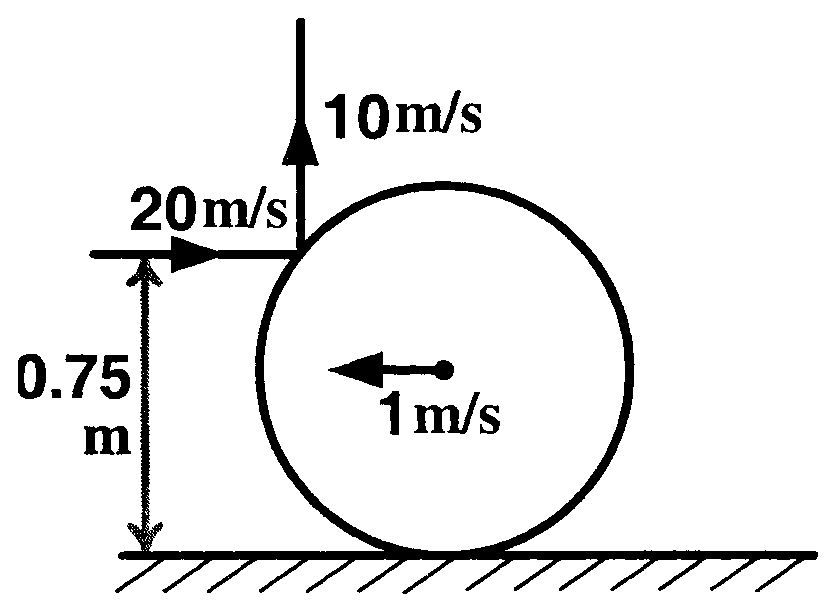
Options
the ring has pure rotation about its stationary CM.
the ring comes to a complete stop.
friction between the ring and the ground is to the left.
there is no friction between the ring and the ground.
Step-by-Step Solution
To determine the motion of the ring immediately after the collision, let us analyze the impulse and momentum of both the ball and the ring.
1. Given Data and Initial State
- Ring:
- Mass
- Radius
- Moment of inertia about CM:
- Initial velocity of center of mass (CM): (moving to the left)
Since the ring is initially rolling without slipping on the horizontal surface, the velocity of the bottommost point is zero:
Thus, the initial angular velocity is in the counter-clockwise direction ().
- Ball:
- Mass
- Initial velocity: (moving to the right)
- Final velocity immediately after collision: (moving vertically upwards)
2. Impulse Calculation
The impulse exerted by the ring on the ball is equal to the change in linear momentum of the ball:
By Newton's third law, the impulse exerted by the ball on the ring is:
Thus, the horizontal impulse acting on the ring is (to the right).
3. Velocity of the Center of Mass Immediately After Collision
Using the impulse-momentum theorem for the center of mass of the ring in the horizontal direction:
Since , the center of mass of the ring comes to rest immediately after the collision.
4. Rotation of the Ring Immediately After Collision
The horizontal impulse acts at height , which is at a vertical distance above the center of mass.
The torque of this horizontal impulse about the center of mass creates a clockwise impulse torque:
The initial angular momentum about the center of mass is:
Even taking into account the vertical impulse component, the final angular momentum remains strictly positive:
Since and , the ring is not at rest, but undergoes pure rotation about its stationary center of mass.
This validates Option A.
5. Direction of Friction Force
The velocity of the point of contact of the ring with the ground immediately after collision is:
Since , the point of contact moves to the right.
To oppose this relative motion (slipping to the right), the friction force exerted by the ground on the ring must act to the left.
This validates Option C.
Conclusion
- (A) The ring has pure rotation about its stationary CM. (Correct)
- (B) The ring comes to a complete stop. (Incorrect)
- (C) Friction between the ring and the ground is to the left. (Correct)
- (D) There is no friction between the ring and the ground. (Incorrect)
Correct Options: A, C