Coefficient of Friction Between Block and Moving Cube Surface
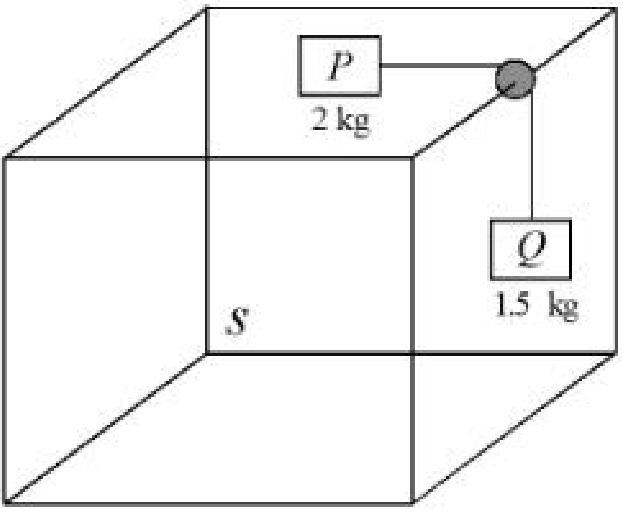
Two blocks ( and ) with respectively masses and are joined by a massless thread. These blocks are mounted on a frictionless pulley which is fixed on the edge of a cube , as shown in the figure below. Block is positioned on the top surface which has no friction and block is in contact with side-surface, having coefficient friction . The cube moves towards the right with acceleration of , where is gravitational acceleration. During this movement the block and remain stationary. The value of is ________.
Options
Topics & Concepts
Step-by-Step Solution
To find the coefficient of friction , we analyze the forces acting on blocks and in the non-inertial reference frame of the cube , which is accelerating to the right with .
In this non-inertial frame, a pseudo force acts on every mass towards the left.
1. Analysis of Block ():
Block lies on the frictionless top surface of the cube.
- Horizontal forces acting on :
- Tension force from the string towards the right (towards the pulley).
- Pseudo force towards the left.
Since block is stationary relative to the cube: Substituting :
2. Analysis of Block ():
Block hangs vertically and touches the side surface of the cube.
-
Horizontal direction:
- The pseudo force pushes block against the vertical side surface of the cube.
- The normal force exerted by the vertical wall on block is equal to this pseudo force:
-
Vertical direction:
- Downward force due to gravity:
- Upward tension force from the string:
- Since , block has a tendency to slide downwards. Therefore, the friction force acts vertically upwards.
For vertical equilibrium of block :
3. Value of Coefficient of Friction :
Using the relation for limiting friction force :
Correct Answer: B ()