Charged Particle Trajectory in Uniform Magnetic Field Region
A uniform magnetic field is present in the region between and (region 2 as shown in the figure) directed normally into the plane of the paper. A particle with charge and momentum moving along the -axis enters region 2 from region 1 at point (). Select the correct statement(s) among the following:
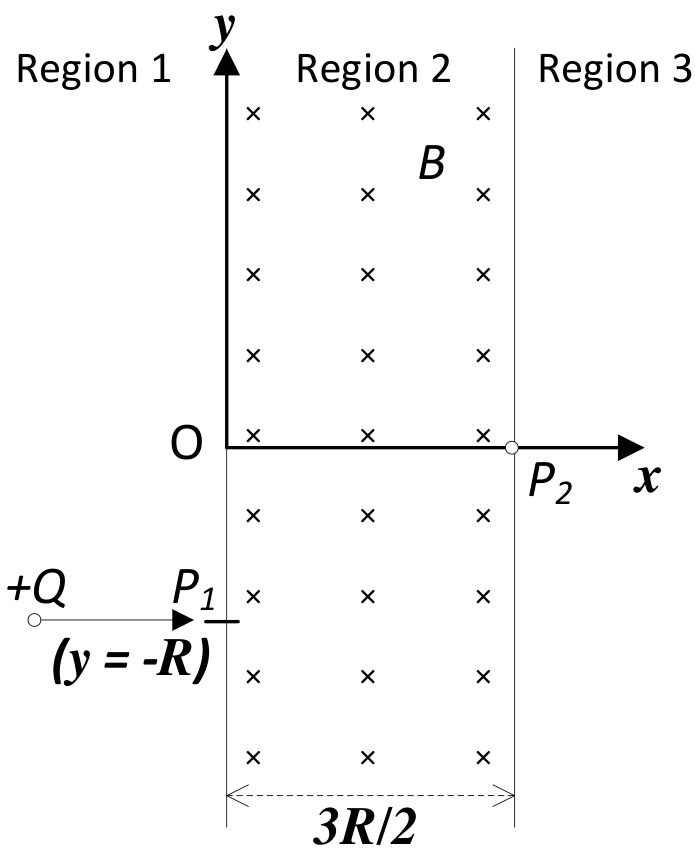
Options
For , the charged particle will re-enter region 1
When , the particle enters region 3 through the point located on the -axis
If the particle re-enters region 1 after following the longest possible path inside region 2, the magnitude of variation in its linear momentum between point and its farthest distance from the -axis equals
For a given value of , among particles possessing identical charge and speed , the separation distance between and the re-entry location into region 1 varies inversely with the mass of the particle
Topics & Concepts
Step-by-Step Solution
To determine the correct option(s), we analyze the motion of the charged particle in the uniform magnetic field.
1. Equation of Motion and Trajectory
- Magnetic field: in Region 2 ().
- Initial position and momentum: Entering at with momentum , which implies initial velocity .
- Magnetic force:
Since the force acts along the -direction, the particle undergoes circular motion in the -plane with radius of curvature:
Because the velocity at is along and the force is along , the center of the circular trajectory is located at:
The equation of the circular trajectory is:
2. Evaluation of Options
Option A:
For the particle to re-enter Region 1 (), the maximum distance it reaches along the -axis must be less than the width of Region 2, which is .
The maximum -coordinate on the circular arc is .
Thus, Option A is correct.
Option B:
Point is located on the -axis () at the boundary between Region 2 and Region 3 (). Hence, .
Substituting and into the equation of the trajectory:
Using :
Thus, Option B is correct.
Option C:
The longest possible path inside Region 2 without escaping into Region 3 corresponds to the maximum possible radius .
- At point , the initial momentum is:
- At the farthest point from the -axis (), the velocity vector is directed along , so the momentum is:
The magnitude of the change in linear momentum is:
Option C states this variation is , which is incorrect. Thus, Option C is incorrect.
Option D:
To find the point of re-entry into Region 1, we set in the trajectory equation:
- (Point , entry point)
- (Re-entry point)
The separation distance between and the re-entry point is:
For given values of , , and , (the distance varies directly with the mass, not inversely). Thus, Option D is incorrect.
Conclusion
The correct options are A and B.