To find the total change in enthalpy (ΔH) for the transformation of state along the sequence X→Y→Z, we use the fundamental thermodynamic principle that enthalpy (H) is a state function for an ideal gas and depends solely on the initial and final temperatures.
1. Identify Given Data
- Number of moles of gas, n=5 mol
- Molar heat capacity at constant volume, Cv,m=12 J K−1 mol−1
- Universal gas constant, R=8.3 J K−1 mol−1
2. Molar Heat Capacity at Constant Pressure (Cp,m)
For an ideal gas, the relationship between Cp,m and Cv,m is given by Mayer's relation:
Cp,m=Cv,m+R
Substituting the given values:
Cp,m=12+8.3=20.3 J K−1 mol−1
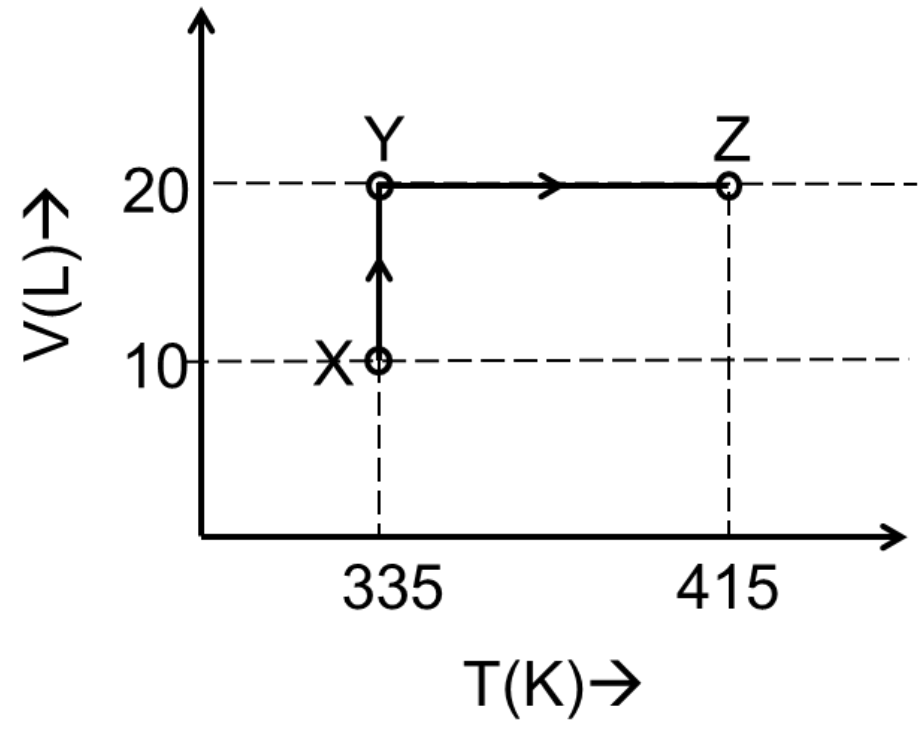
3. Temperature of States from the V–T Diagram
- State X: Temperature TX=335 K, Volume VX=10 L
- State Y: Temperature TY=335 K, Volume VY=20 L
- State Z: Temperature TZ=415 K, Volume VZ=20 L
4. Calculation of Enthalpy Change (ΔH)
Since X→Y is an isothermal process (TX=TY=335 K):
ΔHX→Y=nCp,m(TY−TX)=nCp,m(335−335)=0 J
For the isochoric process Y→Z:
ΔHY→Z=nCp,m(TZ−TY)
ΔHY→Z=5×20.3×(415−335)
ΔHY→Z=5×20.3×80=8120 J
5. Total Change in Enthalpy
ΔHtotal=ΔHX→Y+ΔHY→Z=0+8120=8120 J
Alternatively, directly using the state function property from X to Z:
ΔHtotal=nCp,m(TZ−TX)=5×20.3×(415−335)=8120 J
8120