JEE Challenger
More from Wave Optics

Central Maximum Shift in Youngs Double Slit with Glass Wedges

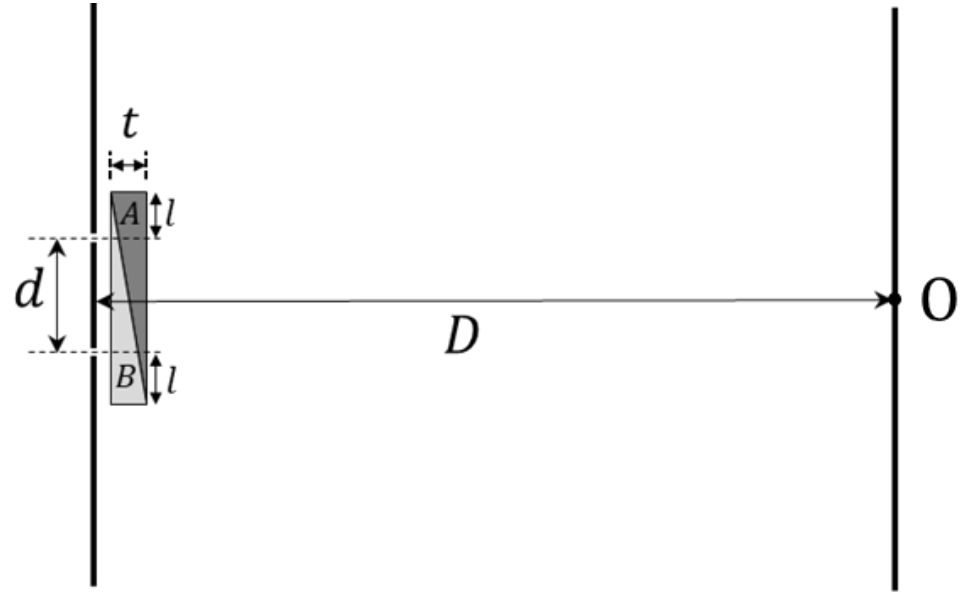
In a Young's double slit experiment, a combination of two glass wedges AA and BB, having refractive indices 1.71.7 and 1.51.5, respectively, are placed in front of the slits, as shown in the figure. The separation between the slits is d=2 mmd = 2\text{ mm} and the shortest distance between the slits and the screen is D=2 mD = 2\text{ m}. Thickness of the combination of the wedges is t=12 μmt = 12\text{ }\mu\text{m}. The value of ll as shown in the figure is 1 mm1\text{ mm}. Neglect any refraction effect at the slanted interface of the wedges. Due to the combination of the wedges, the central maximum shifts (in mm) with respect to O by ______

Question Diagram 1
Official Numerical Answer1.2

Step-by-Step Solution

To find the shift of the central maximum on the screen, we first determine the optical path length introduced by the combination of wedges at the positions of the two slits.

1. Geometry of the Wedges

Let the central axis passing through point OO on the screen be y=0y = 0. The two slits, S1S_1 and S2S_2, are separated by d=2 mmd = 2\text{ mm}. Thus, their position coordinates are:

  • Upper slit S1S_1: y1=+d2=+1 mmy_1 = +\frac{d}{2} = +1\text{ mm}
  • Lower slit S2S_2: y2=d2=1 mmy_2 = -\frac{d}{2} = -1\text{ mm}

The combination of two glass wedges forms a rectangular block of total thickness t=12 μmt = 12\ \mu\text{m}. The total height HH of this rectangular block is: H=d+2l=2 mm+2(1 mm)=4 mmH = d + 2l = 2\text{ mm} + 2(1\text{ mm}) = 4\text{ mm}

The top edge of the block is at ytop=+2 mmy_{\text{top}} = +2\text{ mm} and the bottom edge is at ybottom=2 mmy_{\text{bottom}} = -2\text{ mm}.

The thickness of wedge AA, tA(y)t_A(y), varies linearly from tt at the top edge (y=+2 mmy = +2\text{ mm}) to 00 at the bottom edge (y=2 mmy = -2\text{ mm}): tA(y)=t(y(2)2(2))=t(y+24)t_A(y) = t \left( \frac{y - (-2)}{2 - (-2)} \right) = t \left( \frac{y + 2}{4} \right)

The thickness of wedge BB at height yy is: tB(y)=ttA(y)=t(2y4)t_B(y) = t - t_A(y) = t \left( \frac{2 - y}{4} \right)


2. Optical Path Length (OPL) through the Slits

  • At Slit S1S_1 (y1=+1 mmy_1 = +1\text{ mm}): tA(y1)=t(1+24)=34tt_A(y_1) = t \left( \frac{1 + 2}{4} \right) = \frac{3}{4}t tB(y1)=t(214)=14tt_B(y_1) = t \left( \frac{2 - 1}{4} \right) = \frac{1}{4}t

    The optical path length for the ray passing through S1S_1 within the wedge combination is: OPL1=μAtA(y1)+μBtB(y1)=μA(34t)+μB(14t)=t4(3μA+μB)\text{OPL}_1 = \mu_A t_A(y_1) + \mu_B t_B(y_1) = \mu_A \left(\frac{3}{4}t\right) + \mu_B \left(\frac{1}{4}t\right) = \frac{t}{4}(3\mu_A + \mu_B)

  • At Slit S2S_2 (y2=1 mmy_2 = -1\text{ mm}): tA(y2)=t(1+24)=14tt_A(y_2) = t \left( \frac{-1 + 2}{4} \right) = \frac{1}{4}t tB(y2)=t(2(1)4)=34tt_B(y_2) = t \left( \frac{2 - (-1)}{4} \right) = \frac{3}{4}t

    The optical path length for the ray passing through S2S_2 within the wedge combination is: OPL2=μAtA(y2)+μBtB(y2)=μA(14t)+μB(34t)=t4(μA+3μB)\text{OPL}_2 = \mu_A t_A(y_2) + \mu_B t_B(y_2) = \mu_A \left(\frac{1}{4}t\right) + \mu_B \left(\frac{3}{4}t\right) = \frac{t}{4}(\mu_A + 3\mu_B)


3. Optical Path Difference (ΔOPL\Delta \text{OPL})

The path difference introduced by the wedge combination between the two rays is: ΔOPL=OPL1OPL2=t4((3μA+μB)(μA+3μB))=t2(μAμB)\Delta \text{OPL} = \text{OPL}_1 - \text{OPL}_2 = \frac{t}{4}\Big((3\mu_A + \mu_B) - (\mu_A + 3\mu_B)\Big) = \frac{t}{2}(\mu_A - \mu_B)

Given:

  • μA=1.7\mu_A = 1.7
  • μB=1.5\mu_B = 1.5
  • t=12 μm=12×106 mt = 12\ \mu\text{m} = 12 \times 10^{-6}\text{ m}

ΔOPL=12×106 m2(1.71.5)=6×106×0.2=1.2×10⁶ m\Delta \text{OPL} = \frac{12 \times 10^{-6}\text{ m}}{2} (1.7 - 1.5) = 6 \times 10^{-6} \times 0.2 = 1.2 \times 10^{-6}\text{ m}


4. Shift of Central Maximum

For the central maximum, the net optical path difference between the rays arriving at a point yy on the screen must be zero: Δxgeometric=ΔOPL\Delta x_{\text{geometric}} = \Delta \text{OPL} dyD=ΔOPL\frac{d \cdot y}{D} = \Delta \text{OPL}

Solving for yy: y=DdΔOPLy = \frac{D}{d} \cdot \Delta \text{OPL}

Substitute the values D=2 mD = 2\text{ m} and d=2 mm=2×10³ md = 2\text{ mm} = 2 \times 10^{-3}\text{ m}: y=22×103×(1.2×106)=103×1.2×106 m=1.2×10³ m=1.2 mmy = \frac{2}{2 \times 10^{-3}} \times (1.2 \times 10^{-6}) = 10^3 \times 1.2 \times 10^{-6}\text{ m} = 1.2 \times 10^{-3}\text{ m} = 1.2\text{ mm}

Thus, the central maximum shifts with respect to OO by 1.2 mm.

Central Maximum Shift in Youngs Double Slit with Glass Wedges | Physics PYQ Solution - JEE Challenger