Center of Mass Speed of Cylinder Losing Contact at Corner
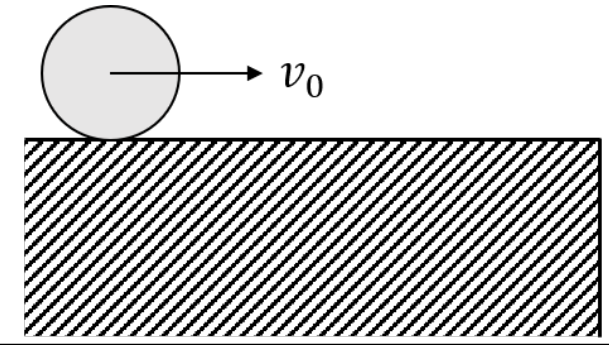
A solid cylinder of radius rolls without slipping with a center of mass speed on a horizontal surface with a vertical edge, as shown in the figure. Here, is the acceleration due to the gravity. At the moment when the cylinder loses contact with the surface due to rotation around the corner, the speed of its center of mass is:
Options
0
Step-by-Step Solution
To find the speed of the center of mass of the cylinder at the moment it loses contact with the corner, we analyze the motion of the cylinder as it rotates about the corner point .
1. Initial State and Moment of Inertia
The cylinder rolls without slipping on the horizontal surface with a center of mass speed . The angular velocity about its center of mass is:
When the cylinder reaches the edge/corner, the point of contact transitions to the corner . Since the position vector of the center of mass relative to is vertical and perpendicular to its initial velocity vector, there is no impulsive force at the transition.
The moment of inertia of the solid cylinder about the corner is given by the parallel axis theorem:
2. Conservation of Mechanical Energy
Let be the angle that the radius vector connecting the corner to the center of mass makes with the vertical.
Taking the initial position at as the reference level for potential energy (), the initial total mechanical energy of the cylinder rotating about is:
Substituting :
At an angle , the height of the center of mass decreases by , so the mechanical energy is:
By conservation of mechanical energy ():
3. Condition for Losing Contact
The radial equation of motion for the center of mass moving in a circular path of radius about is:
where is the normal reaction force exerted by the corner on the cylinder. The cylinder loses contact when :
Substituting :
4. Speed of Center of Mass
The speed of the center of mass at this instant is:
Thus, the correct option is (B).