JEE Challenger
More from Electrostatic Potential and Capacitance

Capacitance of Container Filled with Liquid Dielectric Over Time

A container has a base of 50 cm×5 cm50\text{ cm} \times 5\text{ cm} and height 50 cm50\text{ cm}, as shown in the figure. It has two parallel electrically conducting walls each of area 50 cm×50 cm50\text{ cm} \times 50\text{ cm}. The remaining walls of the container are thin and non-conducting. The container is being filled with a liquid of dielectric constant 33 at a uniform rate of 250 cm3 s1250\text{ cm}^3\text{ s}^{-1}. What is the value of the capacitance of the container after 1010 seconds?

[Given: Permittivity of free space ϵ0=9×10¹² C2N1m2\epsilon_0 = 9 \times 10^{-12}\text{ C}^2\text{N}^{-1}\text{m}^{-2}, the effects of the non-conducting walls on the capacitance are negligible]
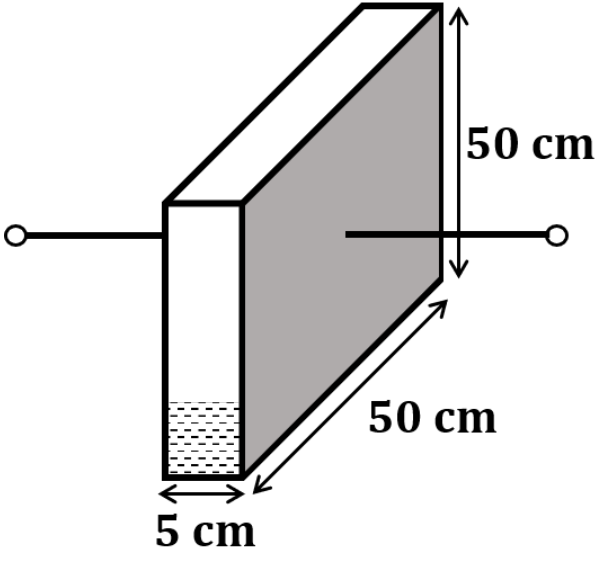
Question Diagram 1

Options

A

27 pF27\text{ pF}

B

63 pF63\text{ pF}

Correct
C

81 pF81\text{ pF}

D

135 pF135\text{ pF}

Step-by-Step Solution

To find the capacitance of the container after 10 seconds10\text{ seconds}, we analyze the system as two capacitors connected in parallel: one filled with the liquid dielectric and the other filled with air.

1. Liquid Level After 10 seconds10\text{ seconds}

The base area of the container is: Abase=50 cm×5 cm=250 cm2A_{\text{base}} = 50\text{ cm} \times 5\text{ cm} = 250\text{ cm}^2

The volume of the liquid filled in t=10 st = 10\text{ s} at a rate of 250 cm3s1250\text{ cm}^3\text{s}^{-1} is: V=250 cm3s1×10 s=2500 cm3V = 250\text{ cm}^3\text{s}^{-1} \times 10\text{ s} = 2500\text{ cm}^3

The height hh of the liquid column at this instant is: h=VAbase=2500 cm3250 cm2=10 cm=0.1 mh = \frac{V}{A_{\text{base}}} = \frac{2500\text{ cm}^3}{250\text{ cm}^2} = 10\text{ cm} = 0.1\text{ m}

The total height of the container is H=50 cm=0.5 mH = 50\text{ cm} = 0.5\text{ m}. Thus, the height of the unfilled (air) portion is: Hh=50 cm10 cm=40 cm=0.4 mH - h = 50\text{ cm} - 10\text{ cm} = 40\text{ cm} = 0.4\text{ m}


2. Capacitance Calculation

The two conducting plates are separated by a distance d=5 cm=0.05 md = 5\text{ cm} = 0.05\text{ m} and have a width of w=50 cm=0.5 mw = 50\text{ cm} = 0.5\text{ m}.

  • Capacitance of the liquid-filled region (C1C_1):

    • Dielectric constant, K=3K = 3
    • Plate area, A1=w×h=0.5 m×0.1 m=0.05 m2A_1 = w \times h = 0.5\text{ m} \times 0.1\text{ m} = 0.05\text{ m}^2 C1=Kϵ0A1d=3×ϵ0×0.050.05=3ϵ0C_1 = \frac{K \epsilon_0 A_1}{d} = \frac{3 \times \epsilon_0 \times 0.05}{0.05} = 3\epsilon_0
  • Capacitance of the air-filled region (C2C_2):

    • Dielectric constant, Kair=1K_{\text{air}} = 1
    • Plate area, A2=w×(Hh)=0.5 m×0.4 m=0.20 m2A_2 = w \times (H - h) = 0.5\text{ m} \times 0.4\text{ m} = 0.20\text{ m}^2 C2=ϵ0A2d=ϵ0×0.200.05=4ϵ0C_2 = \frac{\epsilon_0 A_2}{d} = \frac{\epsilon_0 \times 0.20}{0.05} = 4\epsilon_0

3. Total Equivalent Capacitance

Since the two regions are in parallel, the total capacitance CC is: C=C1+C2=3ϵ0+4ϵ0=7ϵ0C = C_1 + C_2 = 3\epsilon_0 + 4\epsilon_0 = 7\epsilon_0

Substituting the given value ϵ0=9×10¹² C2N1m2=9 pF/m\epsilon_0 = 9 \times 10^{-12}\text{ C}^2\text{N}^{-1}\text{m}^{-2} = 9\text{ pF/m}: C=7×9 pF=63 pFC = 7 \times 9\text{ pF} = 63\text{ pF}

Therefore, the correct option is B.