JEE Challenger
More from Electrostatic Potential and Capacitance

Capacitance Configuration of Four Parallel Metal Sheets with Shorting Combinations

Four identical thin, square metal sheets, S1,S2,S3S_1, S_2, S_3 and S4S_4, each of side aa are kept parallel to each other with equal distance dd (dad \ll a) between them, as shown in the figure. Let C0=ε0a2/dC_0 = \varepsilon_0 a^2 / d, where \varepsilon_0 is the permittivity of free space.

Match the quantities mentioned in List-I with their values in List-II and choose the correct option.
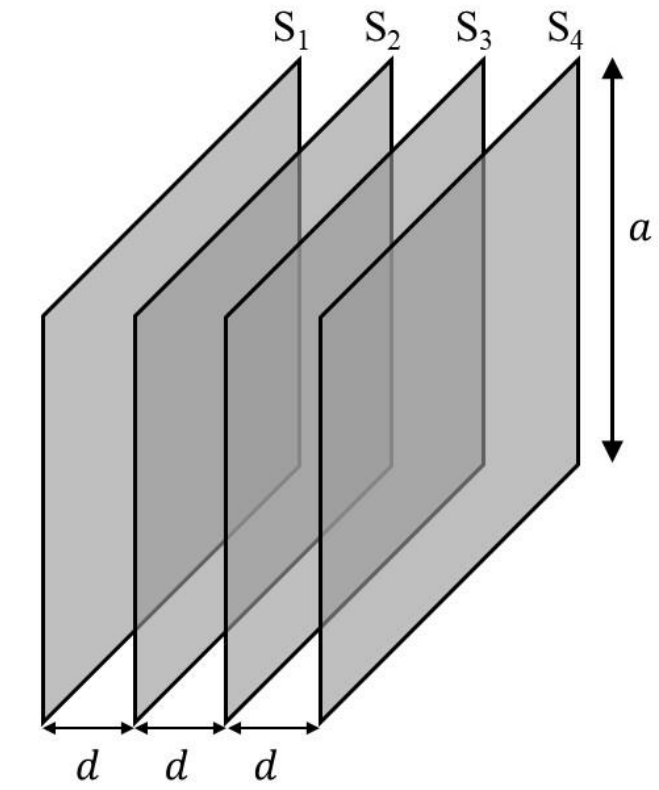
List-IList-II(P) The capacitance between S1 and S4, with S2 and S3 not connected, is(1) 3C0(Q) The capacitance between S1 and S4, with S2 shorted to S3, is(2) C0/2(R) The capacitance between S1 and S3, with S2 shorted to S4, is(3) C0/3(S) The capacitance between S1 and S2, with S3 shorted to S1, and S2 shorted to S4, is(4) 2C0/3(5) 2C0\begin{array}{ll} \text{List-I} & \text{List-II} \\ \text{(P) The capacitance between } S_1 \text{ and } S_4\text{, with } S_2 \text{ and } S_3 \text{ not connected, is} & \text{(1) } 3C_0 \\ \text{(Q) The capacitance between } S_1 \text{ and } S_4\text{, with } S_2 \text{ shorted to } S_3\text{, is} & \text{(2) } C_0/2 \\ \text{(R) The capacitance between } S_1 \text{ and } S_3\text{, with } S_2 \text{ shorted to } S_4\text{, is} & \text{(3) } C_0/3 \\ \text{(S) The capacitance between } S_1 \text{ and } S_2\text{, with } S_3 \text{ shorted to } S_1\text{, and } S_2 \text{ shorted to } S_4\text{, is} & \text{(4) } 2C_0/3 \\ & \text{(5) } 2C_0 \end{array}
Question Diagram 1

Options

A

P3;Q2;R4;S5\text{P} \rightarrow 3; \text{Q} \rightarrow 2; \text{R} \rightarrow 4; \text{S} \rightarrow 5

B

P2;Q3;R2;S1\text{P} \rightarrow 2; \text{Q} \rightarrow 3; \text{R} \rightarrow 2; \text{S} \rightarrow 1

C

P3;Q2;R4;S1\text{P} \rightarrow 3; \text{Q} \rightarrow 2; \text{R} \rightarrow 4; \text{S} \rightarrow 1

Correct
D

P3;Q2;R2;S5\text{P} \rightarrow 3; \text{Q} \rightarrow 2; \text{R} \rightarrow 2; \text{S} \rightarrow 5

Step-by-Step Solution

To find the equivalent capacitance for each configuration, we consider the four parallel metal plates S1,S2,S3,S4S_1, S_2, S_3, S_4. The three regions between adjacent plates form three identical parallel plate capacitors:

  • Capacitor C1C_1 between S1S_1 and S2S_2, with capacitance C1=C0=ε0a2dC_1 = C_0 = \frac{\varepsilon_0 a^2}{d}.
  • Capacitor C2C_2 between S2S_2 and S3S_3, with capacitance C2=C0=ε0a2dC_2 = C_0 = \frac{\varepsilon_0 a^2}{d}.
  • Capacitor C3C_3 between S3S_3 and S4S_4, with capacitance C3=C0=ε0a2dC_3 = C_0 = \frac{\varepsilon_0 a^2}{d}.

Analysis of List-I Items

(P) Capacitance between S1S_1 and S4S_4, with S2S_2 and S3S_3 not connected:

  • The intermediate plates S2S_2 and S3S_3 are isolated.
  • Consequently, the three capacitors C1,C2,C_1, C_2, and C3C_3 are connected in series between S1S_1 and S4S_4.
  • The equivalent capacitance CeqC_{\text{eq}} is: 1Ceq=1C1+1C2+1C3=1C0+1C0+1C0=3C0\frac{1}{C_{\text{eq}}} = \frac{1}{C_1} + \frac{1}{C_2} + \frac{1}{C_3} = \frac{1}{C_0} + \frac{1}{C_0} + \frac{1}{C_0} = \frac{3}{C_0} Ceq=C03C_{\text{eq}} = \frac{C_0}{3}
  • Thus, P(3)\text{P} \rightarrow (3).

(Q) Capacitance between S1S_1 and S4S_4, with S2S_2 shorted to S3S_3:

  • Since S2S_2 is shorted to S3S_3, V(S2)=V(S3)V(S_2) = V(S_3). The potential difference across C2C_2 is zero, meaning C2C_2 carries no charge.
  • The remaining capacitors C1C_1 (between S1S_1 and S2S_2) and C3C_3 (between S3S_3 and S4S_4) are connected in series through the common shorted node (S2S3)(S_2 \cup S_3).
  • The equivalent capacitance CeqC_{\text{eq}} is: Ceq=C1C3C1+C3=C0C0C0+C0=C02C_{\text{eq}} = \frac{C_1 \cdot C_3}{C_1 + C_3} = \frac{C_0 \cdot C_0}{C_0 + C_0} = \frac{C_0}{2}
  • Thus, Q(2)\text{Q} \rightarrow (2).

(R) Capacitance between S1S_1 and S3S_3, with S2S_2 shorted to S4S_4:

  • Let AA be terminal S1S_1, BB be terminal S3S_3, and XX be the shorted node (S2S4)(S_2 \cup S_4).
  • Analyzing the connections:
    • C1C_1 is connected between terminal AA (S1S_1) and node XX (S2S_2).
    • C2C_2 is connected between node XX (S2S_2) and terminal BB (S3S_3).
    • C3C_3 is connected between terminal BB (S3S_3) and node XX (S4S_4).
  • Capacitors C2C_2 and C3C_3 are connected in parallel between node XX and terminal BB: C23=C2+C3=C0+C0=2C0C_{23} = C_2 + C_3 = C_0 + C_0 = 2C_0
  • This parallel combination C23C_{23} is in series with C1C_1: Ceq=C1C23C1+C23=C0(2C0)C0+2C0=2C03C_{\text{eq}} = \frac{C_1 \cdot C_{23}}{C_1 + C_{23}} = \frac{C_0 \cdot (2C_0)}{C_0 + 2C_0} = \frac{2C_0}{3}
  • Thus, R(4)\text{R} \rightarrow (4).

(S) Capacitance between S1S_1 and S2S_2, with S3S_3 shorted to S1S_1, and S2S_2 shorted to S4S_4:

  • Plates S1S_1 and S3S_3 are shorted to form terminal A=S1S3A = S_1 \cup S_3.
  • Plates S2S_2 and S4S_4 are shorted to form terminal B=S2S4B = S_2 \cup S_4.
  • Analyzing the connections:
    • C1C_1 is connected between S1S_1 (terminal AA) and S2S_2 (terminal BB).
    • C2C_2 is connected between S2S_2 (terminal BB) and S3S_3 (terminal AA).
    • C3C_3 is connected between S3S_3 (terminal AA) and S4S_4 (terminal BB).
  • All three capacitors C1,C2,C_1, C_2, and C3C_3 are connected in parallel between terminals AA and BB: Ceq=C1+C2+C3=C0+C0+C0=3C0C_{\text{eq}} = C_1 + C_2 + C_3 = C_0 + C_0 + C_0 = 3C_0
  • Thus, S(1)\text{S} \rightarrow (1).

Conclusion

The correct matching is: P3;Q2;R4;S1\text{P} \rightarrow 3; \quad \text{Q} \rightarrow 2; \quad \text{R} \rightarrow 4; \quad \text{S} \rightarrow 1

This corresponds to Option C.

Capacitance Configuration of Four Parallel Metal Sheets with Shorting Combinations | Physics PYQ Solution - JEE Challenger