JEE Challenger
More from Aldehydes, Ketones and Carboxylic Acids

Calculation of Product Mass in Multi Step Organic Synthesis from Bromophenyl Acetal

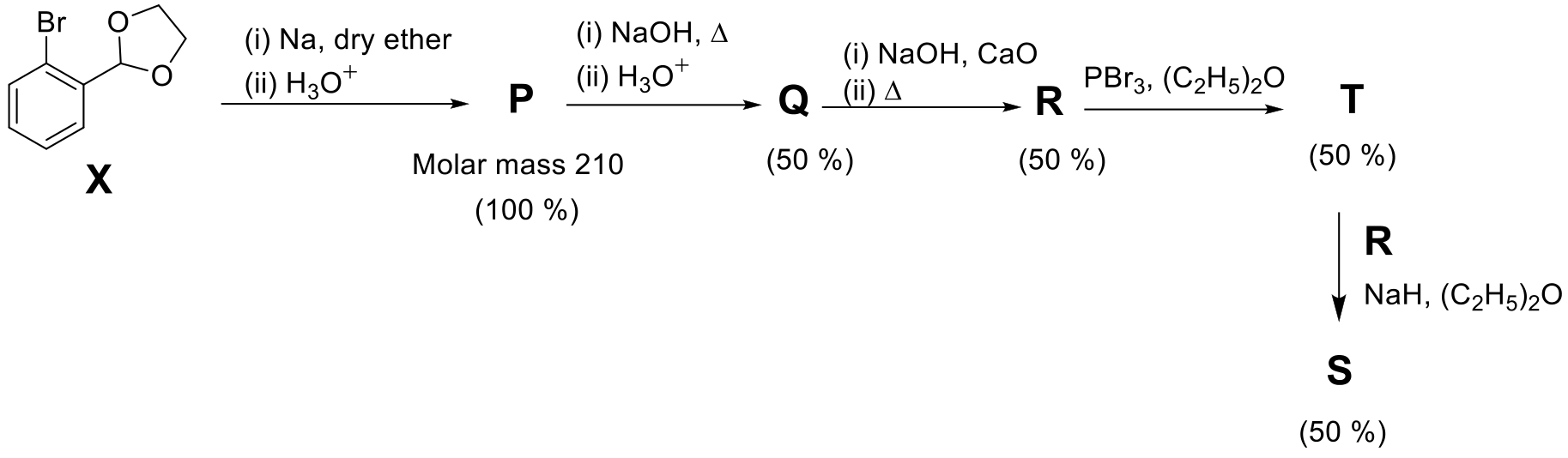
The reaction sequence given below is carried out with 16 moles16\text{ moles} of X\mathbf{X}. The yield of the major product in each step is given below the product in parentheses. The amount (in grams) of S\mathbf{S} produced is _______.

Use: Atomic mass (in amu): H=1,C=12,O=16,Br=80\text{Use: Atomic mass (in amu): } \text{H} = 1, \text{C} = 12, \text{O} = 16, \text{Br} = 80

Question Diagram 1
Official Numerical Answer175

Step-by-Step Solution

To determine the amount of S\mathbf{S} produced, we analyze the reaction steps sequentially:

Step 1: Formation of P\mathbf{P}

  • Starting material X\mathbf{X}: 2-(2-bromophenyl)-1,3-dioxolane (C9H9BrO2\text{C}_9\text{H}_9\text{BrO}_2).
  • Reagents: (i) Na\text{Na}, dry ether (Wurtz-Fittig coupling) followed by (ii) H3O+\text{H}_3\text{O}^+ (acidic hydrolysis of the acetal protecting groups).
  • Reaction: Two molecules of X\mathbf{X} couple to form a biaryl intermediate, which upon hydrolysis of both acetals yields biphenyl-2,2'-dicarboxaldehyde (P\mathbf{P}). Formula of P:C14H10O2\text{Formula of } \mathbf{P}: \text{C}_{14}\text{H}_{10}\text{O}_2 Molar mass of P=(14×12)+(10×1)+(2×16)=168+10+32=210 g/mol\text{Molar mass of } \mathbf{P} = (14 \times 12) + (10 \times 1) + (2 \times 16) = 168 + 10 + 32 = 210\text{ g/mol}
  • Moles of P\mathbf{P} produced: Moles of P=16 moles of X2×100%=8 moles\text{Moles of } \mathbf{P} = \frac{16\text{ moles of } \mathbf{X}}{2} \times 100\% = 8\text{ moles}

Step 2: Formation of Q\mathbf{Q}

  • Reagents: (i) NaOH,Δ\text{NaOH}, \Delta (Intramolecular Cannizzaro reaction) followed by (ii) H3O+\text{H}_3\text{O}^+.
  • Product Q\mathbf{Q}: 2'-(hydroxymethyl)-[1,1'-biphenyl]-2-carboxylic acid (C14H12O3\text{C}_{14}\text{H}_{12}\text{O}_3).
  • Moles of Q\mathbf{Q} produced: Moles of Q=8 moles×50%=4 moles\text{Moles of } \mathbf{Q} = 8\text{ moles} \times 50\% = 4\text{ moles}

Step 3: Formation of R\mathbf{R}

  • Reagents: (i) NaOH, CaO\text{NaOH, CaO} (ii) Δ\Delta (Decarboxylation with soda lime).
  • Product R\mathbf{R}: [1,1'-biphenyl]-2-ylmethanol (C13H12O\text{C}_{13}\text{H}_{12}\text{O}).
  • Moles of R\mathbf{R} produced: Moles of R=4 moles×50%=2 moles\text{Moles of } \mathbf{R} = 4\text{ moles} \times 50\% = 2\text{ moles}

Step 4: Formation of T\mathbf{T}

  • Reagents: PBr3,(C2H5)2O\text{PBr}_3, (\text{C}_2\text{H}_5)_2\text{O} (Bromination of alcohol).
  • Product T\mathbf{T}: 2-(bromomethyl)-1,1'-biphenyl (C13H11Br\text{C}_{13}\text{H}_{11}\text{Br}).
  • Moles of T\mathbf{T} produced: Moles of T=2 moles×50%=1 mole\text{Moles of } \mathbf{T} = 2\text{ moles} \times 50\% = 1\text{ mole}

Step 5: Formation of S\mathbf{S}

  • Reagents: R+NaH,(C2H5)2O\mathbf{R} + \text{NaH}, (\text{C}_2\text{H}_5)_2\text{O} (Williamson ether synthesis).
  • Reaction: Nucleophilic substitution between the alkoxide of R\mathbf{R} and alkyl bromide T\mathbf{T} gives the ether S\mathbf{S}: S:bis([1,1-biphenyl]2-ylmethyl) ether (C26H22O)\mathbf{S}: \text{bis}([1,1'\text{-biphenyl}]-2\text{-ylmethyl})\text{ ether } (\text{C}_{26}\text{H}_{22}\text{O})
  • Moles of S\mathbf{S} produced: Moles of S=1 mole of T×50%=0.5 moles\text{Moles of } \mathbf{S} = 1\text{ mole of } \mathbf{T} \times 50\% = 0.5\text{ moles}

Calculation of Molar Mass and Mass of S\mathbf{S}:

  • Molar Mass of S\mathbf{S} (C26H22O\text{C}_{26}\text{H}_{22}\text{O}): MS=(26×12)+(22×1)+(1×16)=312+22+16=350 g/molM_{\mathbf{S}} = (26 \times 12) + (22 \times 1) + (1 \times 16) = 312 + 22 + 16 = 350\text{ g/mol}

  • Mass of S\mathbf{S}: Mass=Moles×Molar Mass=0.5 moles×350 g/mol=175 g\text{Mass} = \text{Moles} \times \text{Molar Mass} = 0.5\text{ moles} \times 350\text{ g/mol} = 175\text{ g}

Answer: 175

Calculation of Product Mass in Multi Step Organic Synthesis from Bromophenyl Acetal | Chemistry PYQ Solution - JEE Challenger