Calculate Sum of Stoichiometric Coefficients from Limiting Molar Conductivity
Consider strong electrolytes ZmXn, UmYp, and VmXn. Given that the limiting molar conductivity (Λ0) of UmYp and VmXn are 250 S cm2 mol−1 and 440 S cm2 mol−1, respectively. Determine the value of (m+n+p).
Given:
Ionλ0 (S cm2 mol−1)Zn+50.0Up+25.0Vn+100.0Xm−80.0Ym−100.0
where λ0 is the limiting molar conductivity of individual ions.
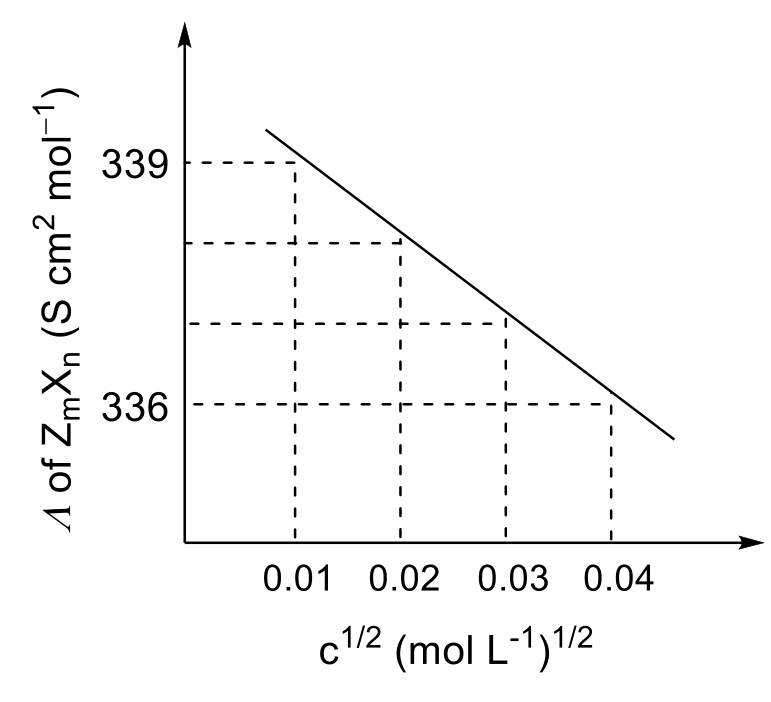
The variation of molar conductivity (Λ) of ZmXn with respect to c1/2 is illustrated in the plot below.
To determine the value of (m+n+p), we apply Kohlrausch's law of independent migration of ions to the given strong electrolytes.
1. Extrapolation of Limiting Molar Conductivity of ZmXn
The variation of molar conductivity (Λ) with concentration c for a strong electrolyte is given by the Debye-Hückel-Onsager equation:
Λ=Λ0−bc
From the provided plot of Λ vs c1/2 for ZmXn:
At c1/2=0.01 (mol L−1)1/2, Λ=339 S cm2 mol−1
At c1/2=0.04 (mol L−1)1/2, Λ=336 S cm2 mol−1
The slope b is calculated as:
b=−Δ(c1/2)ΔΛ=−0.04−0.01336−339=100 S cm2 mol−1(mol L−1)−1/2
The limiting molar conductivity (Λ0) of ZmXn is the y-intercept at c1/2=0:
Λ0(ZmXn)=339+100×0.01=340 S cm2 mol−1
2. Formulating Equations using Kohlrausch's Law
By Kohlrausch's law, the limiting molar conductivity of an electrolyte is the sum of the limiting ionic conductivities of its constituent ions multiplied by their respective stoichiometric coefficients:
For UmYp:Λ0(UmYp)=m⋅λ0(Up+)+p⋅λ0(Ym−)250=m(25.0)+p(100.0)
Dividing the equation by 25:
m+4p=10— (Equation 1)
For VmXn:Λ0(VmXn)=m⋅λ0(Vn+)+n⋅λ0(Xm−)440=m(100.0)+n(80.0)
Dividing the equation by 20:
5m+4n=22— (Equation 2)
For ZmXn:Λ0(ZmXn)=m⋅λ0(Zn+)+n⋅λ0(Xm−)340=m(50.0)+n(80.0)
Dividing the equation by 10:
5m+8n=34— (Equation 3)
3. Solving for m,n, and p
Subtracting Equation 2 from Equation 3:
(5m+8n)−(5m+4n)=34−224n=12⟹n=3
Substituting n=3 into Equation 2:
5m+4(3)=225m=10⟹m=2