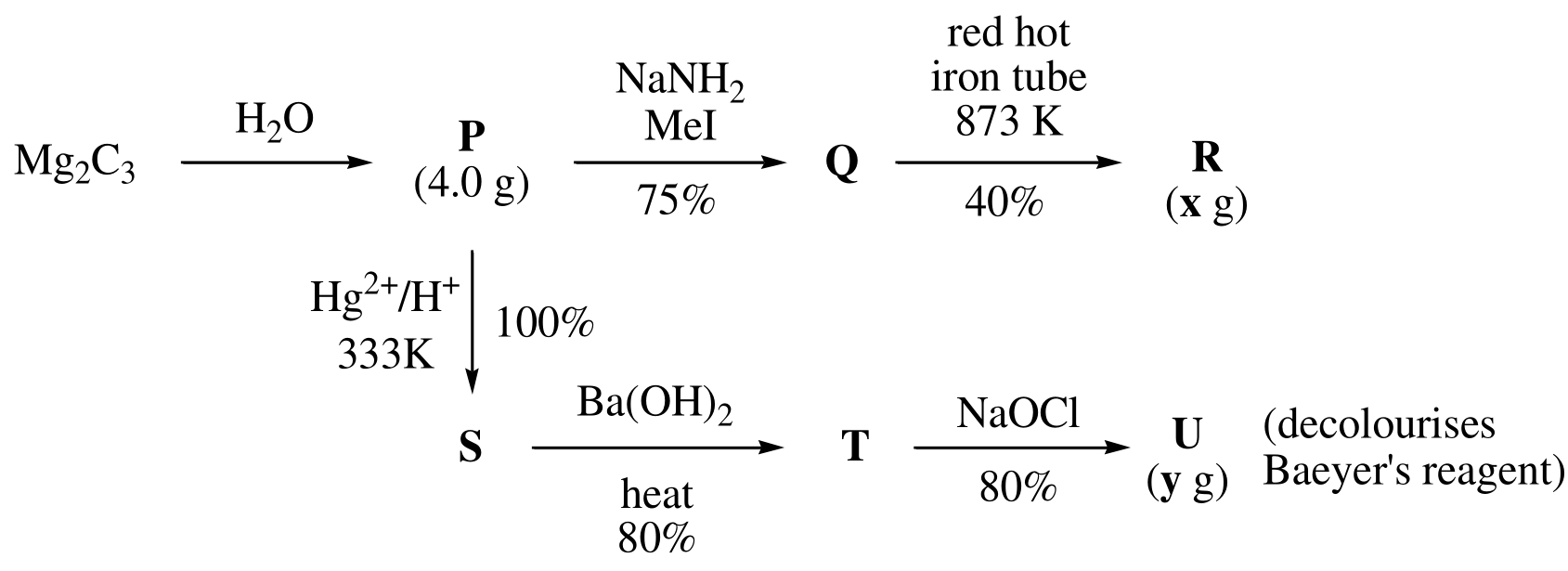
To determine the mass of product R (x g), we analyze the step-by-step chemical transformations and stoichiometry:
Step 1: Identification of Compound P and calculation of its moles
Hydrolysis of magnesium dicarbide (Mg2C3) yields propyne (P):
Mg2C3+4H2O→2Mg(OH)2+CH3-C≡CH
Compound P: Propyne (C3H4)
Molar mass of P (C3H4):Molar Mass=(3×12)+(4×1)=40 g mol−1
Given mass of P:4.0 g
Moles of P:nP=40 g mol−14.0 g=0.1 mol
Step 2: Formation of Compound Q
Propyne (P) undergoes terminal alkyne deprotonation using NaNH2, followed by alkylation with methyl iodide (CH3I) to form but-2-yne (Q):
CH3-C≡CHNaNH2CH3-C≡C−Na+CH3ICH3-C≡C-CH3
Compound Q: But-2-yne (C4H6)
Reaction yield:75%
Moles of Q formed:nQ=nP×10075=0.1×0.75=0.075 mol
Step 3: Trimerization of Q to form Compound R
Passing but-2-yne (Q) through a red-hot iron tube at 873 K causes cyclic trimerization to form hexamethylbenzene (R):
3CH3-C≡C-CH3red hot iron tube873 KC6(CH3)6
Compound R: Hexamethylbenzene (C12H18)
Stoichiometry:3 moles of Q→1 mole of R
Theoretical moles of R:nR,theoretical=3nQ=30.075=0.025 mol
Reaction yield:40%
Actual moles of R:nR,actual=0.025×10040=0.010 mol
Step 4: Calculation of the Mass of Compound R (x)
Molar mass of R (C12H18):Molar Mass=(12×12)+(18×1)=144+18=162 g mol−1
Mass of R (x g):x=nR,actual×Molar Mass of R=0.010 mol×162 g mol−1=1.62 g