Calculate Initial Velocity of Block Attached to Spring with Friction
A block of mass is attached to a spring of force-constant . The coefficient of friction between the block and the floor is . Initially the block is at rest and the spring is un-stretched. An impulse is given to the block as shown in the figure. The block slides a distance of and comes to rest for the first time. The initial velocity of the block in is . Then is
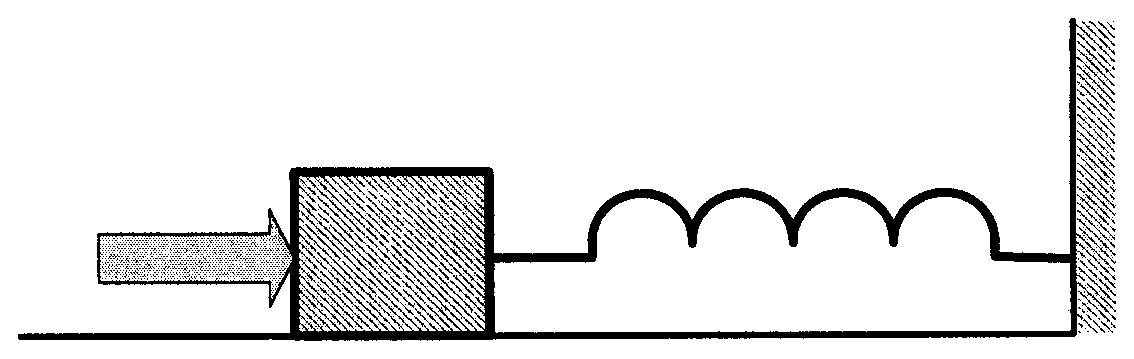
Topics & Concepts
Step-by-Step Solution
To find the value of , we apply the Work-Energy Theorem to the block from the instant right after the impulse is delivered until it comes to rest for the first time.
1. Given Data:
- Mass of the block,
- Force constant of the spring,
- Coefficient of kinetic friction,
- Distance moved by the block,
- Acceleration due to gravity,
- Initial speed after impulse,
- Final speed when it comes to rest,
2. Work-Energy Theorem:
The Work-Energy Theorem states that the net work done on the block equals its change in kinetic energy:
Where:
-
Work done by the spring force:
-
Work done by the frictional force:
-
Initial kinetic energy:
-
Final kinetic energy:
3. Setting up the Equation:
Substituting these expressions into the work-energy relation:
Multiplying both sides by :
Dividing by :
4. Numerical Calculation:
Substitute the given values into the equation:
-
Spring term:
-
Friction term:
Adding the two components together:
Taking the square root:
5. Finding :
We are given that . Equating the two values: