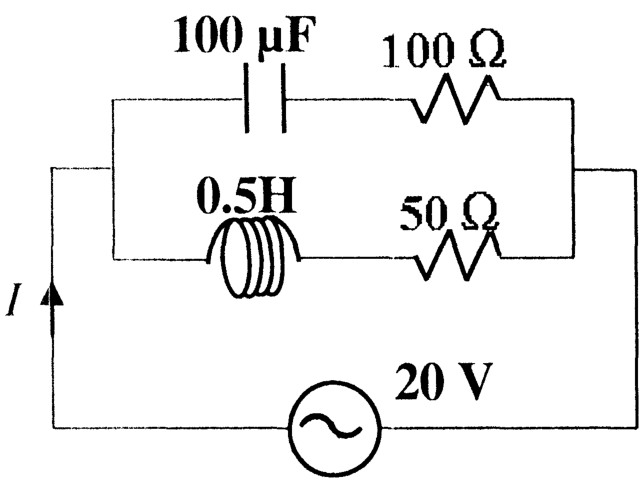
To solve the given problem, we analyze the two parallel branches connected across the AC voltage source of V = 20 V V = 20\text{ V} V = 20 V ω = 100 rad/s \omega = 100\text{ rad/s} ω = 100 rad/s
1. Impedance Analysis of Each Branch Branch 1 (Top Branch: C = 100 μ F C = 100\ \mu\text{F} C = 100 μ F R 1 = 100 Ω R_1 = 100\ \Omega R 1 = 100 Ω
Capacitive Reactance (X C X_C X C
X C = 1 ω C = 1 100 × 100 × 10 − 6 = 100 Ω X_C = \frac{1}{\omega C} = \frac{1}{100 \times 100 \times 10^{-6}} = 100\ \Omega X C = ω C 1 = 100 × 100 × 1 0 − 6 1 = 100 Ω
Branch Impedance (Z 1 Z_1 Z 1
Z 1 = R 1 − j X C = 100 − j 100 Ω Z_1 = R_1 - jX_C = 100 - j100\ \Omega Z 1 = R 1 − j X C = 100 − j 100 Ω
Magnitude of Z 1 Z_1 Z 1
∣ Z 1 ∣ = 100 2 + ( − 100 ) 2 = 100 2 Ω |Z_1| = \sqrt{100^2 + (-100)^2} = 100\sqrt{2}\ \Omega ∣ Z 1 ∣ = 10 0 2 + ( − 100 ) 2 = 100 2 Ω
Branch 2 (Bottom Branch: L = 0.5 H L = 0.5\text{ H} L = 0.5 H R 2 = 50 Ω R_2 = 50\ \Omega R 2 = 50 Ω
Inductive Reactance (X L X_L X L
X L = ω L = 100 × 0.5 = 50 Ω X_L = \omega L = 100 \times 0.5 = 50\ \Omega X L = ω L = 100 × 0.5 = 50 Ω
Branch Impedance (Z 2 Z_2 Z 2
Z 2 = R 2 + j X L = 50 + j 50 Ω Z_2 = R_2 + jX_L = 50 + j50\ \Omega Z 2 = R 2 + j X L = 50 + j 50 Ω
Magnitude of Z 2 Z_2 Z 2
∣ Z 2 ∣ = 50 2 + 50 2 = 50 2 Ω |Z_2| = \sqrt{50^2 + 50^2} = 50\sqrt{2}\ \Omega ∣ Z 2 ∣ = 5 0 2 + 5 0 2 = 50 2 Ω
2. Calculation of Voltages Across Resistors
Current in Branch 1 (I 1 I_1 I 1
I 1 = V ∣ Z 1 ∣ = 20 100 2 = 1 5 2 A I_1 = \frac{V}{|Z_1|} = \frac{20}{100\sqrt{2}} = \frac{1}{5\sqrt{2}}\text{ A} I 1 = ∣ Z 1 ∣ V = 100 2 20 = 5 2 1 A
Voltage across the 100 Ω 100\ \Omega 100 Ω V 100 Ω V_{100\,\Omega} V 100 Ω
V 100 Ω = I 1 × R 1 = ( 1 5 2 ) × 100 = 20 2 = 10 2 V V_{100\,\Omega} = I_1 \times R_1 = \left(\frac{1}{5\sqrt{2}}\right) \times 100 = \frac{20}{\sqrt{2}} = 10\sqrt{2}\text{ V} V 100 Ω = I 1 × R 1 = ( 5 2 1 ) × 100 = 2 20 = 10 2 V (This matches statement C )
Current in Branch 2 (I 2 I_2 I 2
I 2 = V ∣ Z 2 ∣ = 20 50 2 = 2 5 2 A I_2 = \frac{V}{|Z_2|} = \frac{20}{50\sqrt{2}} = \frac{2}{5\sqrt{2}}\text{ A} I 2 = ∣ Z 2 ∣ V = 50 2 20 = 5 2 2 A
Voltage across the 50 Ω 50\ \Omega 50 Ω V 50 Ω V_{50\,\Omega} V 50 Ω
V 50 Ω = I 2 × R 2 = ( 2 5 2 ) × 50 = 20 2 = 10 2 V V_{50\,\Omega} = I_2 \times R_2 = \left(\frac{2}{5\sqrt{2}}\right) \times 50 = \frac{20}{\sqrt{2}} = 10\sqrt{2}\text{ V} V 50 Ω = I 2 × R 2 = ( 5 2 2 ) × 50 = 2 20 = 10 2 V (Statement D claims 10 V 10\text{ V} 10 V
3. Calculation of Total Current (I I I Taking the source voltage phasor as V ~ = 20 ∠ 0 ∘ V \tilde{V} = 20\angle 0^\circ\text{ V} V ~ = 20∠ 0 ∘ V
Branch 1 Current Phasor (I ~ 1 \tilde{I}_1 I ~ 1
I ~ 1 = V ~ Z 1 = 20 100 − j 100 = 20 ( 1 + j ) 200 = ( 0.1 + j 0.1 ) A \tilde{I}_1 = \frac{\tilde{V}}{Z_1} = \frac{20}{100 - j100} = \frac{20(1 + j)}{200} = (0.1 + j0.1)\text{ A} I ~ 1 = Z 1 V ~ = 100 − j 100 20 = 200 20 ( 1 + j ) = ( 0.1 + j 0.1 ) A
Branch 2 Current Phasor (I ~ 2 \tilde{I}_2 I ~ 2
I ~ 2 = V ~ Z 2 = 20 50 + j 50 = 20 ( 1 − j ) 100 = ( 0.2 − j 0.2 ) A \tilde{I}_2 = \frac{\tilde{V}}{Z_2} = \frac{20}{50 + j50} = \frac{20(1 - j)}{100} = (0.2 - j0.2)\text{ A} I ~ 2 = Z 2 V ~ = 50 + j 50 20 = 100 20 ( 1 − j ) = ( 0.2 − j 0.2 ) A
Total Current Phasor (I ~ \tilde{I} I ~
I ~ = I ~ 1 + I ~ 2 = ( 0.1 + j 0.1 ) + ( 0.2 − j 0.2 ) = ( 0.3 − j 0.1 ) A \tilde{I} = \tilde{I}_1 + \tilde{I}_2 = (0.1 + j0.1) + (0.2 - j0.2) = (0.3 - j0.1)\text{ A} I ~ = I ~ 1 + I ~ 2 = ( 0.1 + j 0.1 ) + ( 0.2 − j 0.2 ) = ( 0.3 − j 0.1 ) A
Magnitude of Total Current (I I I
I = ∣ I ~ ∣ = ( 0.3 ) 2 + ( − 0.1 ) 2 = 0.10 ≈ 0.316 A ≈ 0.3 A I = |\tilde{I}| = \sqrt{(0.3)^2 + (-0.1)^2} = \sqrt{0.10} \approx 0.316\text{ A} \approx 0.3\text{ A} I = ∣ I ~ ∣ = ( 0.3 ) 2 + ( − 0.1 ) 2 = 0.10 ≈ 0.316 A ≈ 0.3 A
(The active component of the total current is 0.3 A 0.3\text{ A} 0.3 A A correct)
Conclusion The correct options are A and C .