Calculate Coefficient of Friction Between Stick and Rolling Ring
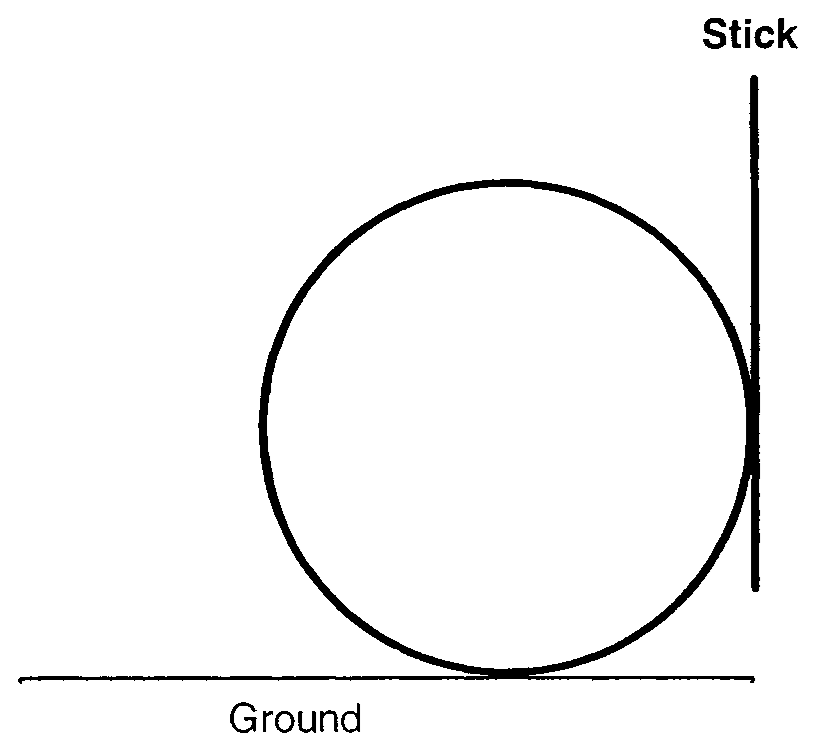
A boy is pushing a ring of mass and radius with a stick as shown in the figure. The stick applies a force of on the ring and rolls it without slipping with an acceleration of . The coefficient of friction between the ground and the ring is large enough that rolling always occurs and the coefficient of friction between the stick and the ring is . The value of is
Step-by-Step Solution
To find the value of , we analyze the translational and rotational motion of the ring.
Given Data:
- Mass of the ring,
- Radius of the ring,
- Force applied by the stick (normal force on the ring),
- Linear acceleration of the ring,
- Coefficient of friction between the stick and the ring,
1. Condition for Pure Rolling
Since the ring rolls without slipping on the ground, the relation between the linear acceleration and the angular acceleration is:
2. Equations of Motion
A. Translational Motion (Horizontal Direction)
Assuming the stick pushes the ring to the left with normal force , the ring accelerates to the left. The static friction force from the ground, , opposes this motion and acts towards the right.
Using Newton's second law for horizontal motion:
Substitute the known values:
B. Rotational Motion (Torque about Center of Mass)
Taking the counterclockwise rotation as positive:
- The moment of inertia of a ring about its central axis is .
- The friction force from the ground, , acts to the right at the bottom point, creating a counterclockwise torque:
- The friction force from the stick, , acts at the rightmost contact point of the ring. To oppose the upward relative velocity of the contact point on the rotating ring, acts downwards, creating a clockwise torque:
Using Newton's second law for rotation:
Dividing both sides by :
3. Calculation of Friction Force and
Substitute , , and :
The friction force exerted by the stick on the ring is given by:
Substitute and :
Given that :